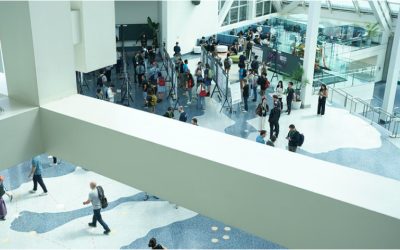
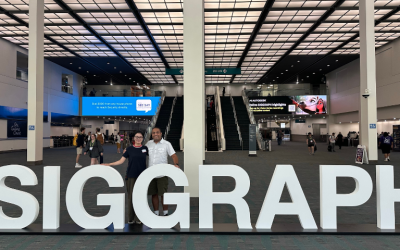
Image Credit: Jia Sun, Algorithmic Miner, 2025.
SIGGRAPH 2025 was truly a special event that saw submissions from over 2,000 contributors. As we reflect on the great work from this year’s event, we caught up with the team from “Algorithmic Miner: Humanity in Service – An AI-Driven VR Journey into Machine Logic“, a contribution to the Art Papers program. Our conversation with Jia Sun and Zheng Wei from the Hong Kong University of Science and Technology (Guangzhou) and Pan Hui from the Center for Metaverse and Computational Creativity (MC2 Lab) focuses on the human side of artificial intelligence and how their work shines a new light on how AI is more than just a machine.
SIGGRAPH: It was great to see your work, “Algorithmic Miner: Humanity in Service – An AI-Driven VR Journey into Machine Logic”, as part of the SIGGRAPH 2025 Art Papers program. For those who could not make it to SIGGRAPH 2025 or attend your session, can you provide some insight into your work?
Algorithmic Miner is a VR interactive work about the invisible labor behind AI. We often imagine clever machines, yet their “intelligence” rests on the repetitive annotation of countless people. In the installation, participants perform three labeling tasks — image classification, sentiment tagging, and object restoration — progressing from the seemingly simple to the increasingly constrained, mirroring how human creativity is compressed into following machine rules. As tasks are completed, golden jellyfish slowly ascend — beautiful yet emblematic of labor abstracted and commodified.
SIGGRAPH: Your work explores the exploitation and marginalization of data annotation workers, whose labor is fundamental to the advancement of artificial intelligence (AI) and machine learning (ML). What was the spark or inspiration for you to pursue this angle?
The spark was the work’s invisibility. “Human mining” treats people’s time, attention, and expertise as extractable resources — atomized by platforms and algorithms, paid by the piece, instantly replaceable. In data labeling, this extraction hides behind layers of outsourcing and crowdsourcing. We celebrate AI’s breakthroughs but seldom acknowledge the workers behind them — precarious, repetitive, low-paid labor. We use VR not as a tech demo, but as a critical medium to let people step onto that invisible assembly line and question the social and ethical costs of technological progress.
SIGGRAPH: As you compiled your research, did you run into any roadblocks? Whether it was developing the installation or obtaining the content about laborers.
Yes. Technically, building a VR experience that simulates repetitive labor without driving people away is hard. We struggled with the “games should be fun” maxim — should this be more entertaining? We later realized not all interactive works aim for fun; here, measured tedium, passivity, and constraint are part of the narrative, letting audiences feel their agency swallowed by rules. That doesn’t justify roughness, though — the interaction must stay smooth to avoid pointless frustration.
On the research side, information about data workers is fragmented and obscured, and platforms say little about how labor is organized. We had to piece the picture together from scattered reports and stray testimonies. Those “invisible” obstacles are precisely why this work is necessary.
SIGGRAPH: Why did you choose to submit your work to the SIGGRAPH 2025 Art Papers program? What does it mean to you to be part of such a special event with bright minds in the computer graphics and interactive techniques industry?
SIGGRAPH is one of the most influential venues in computer graphics and interactive techniques, and Art Papers uniquely brings technology into dialogue with critical social inquiry. For me, participating in SIGGRAPH means speaking with those shaping the future of immersive tech while reminding us that these tools always have human and ethical dimensions. It is both an honor and a responsibility. Creating for SIGGRAPH is work in conversation with the future.
SIGGRAPH: What is one takeaway about your work that you hope resonates with attendees and blog readers?
I want us to recognize that AI is not just about machines — it’s about people. Every “intelligent” system we use rests on invisible human labor, and that deserves acknowledgment. More broadly, we should ask: What do we really mean by “progress,” and who bears its costs? If that question still echoes after you’ve experienced the work, then it has done its job.
SIGGRAPH 2026 is returning to Los Angeles, 19-23 July, at the Los Angeles Convention Center. Be sure to bookmark the 2026 event website so you don’t miss a beat about SIGGRAPH 2026.

Jia Sun is a PhD at the Hong Kong University of Science and Technology (Guangzhou), supervised by Prof. Pan Hui and Prof. James She. As a practice-based artist and researcher, Sun focuses on human-computer interaction, extended reality (XR), and AI-driven immersive learning. Their work bridges critical theory and creative practice, designing digital experiences for art, education, and cultural heritage. Sun’s research explores digital human modeling, interactive installations, and the development of immersive environments.

Zheng Wei is a PhD candidate in the VisLab at The Hong Kong University of Science and Technology, supervised by Prof. Huamin Qu with co-supervisors Prof. Pan Hui and Prof. Anyi Rao. His research advances visual analytics and human-centered AI for visual content creation, drawing on immersive HCI, cinematic data storytelling, and multi-agent co-creation. He is currently a visiting researcher at the University of Chicago’s Knowledge Lab, collaborating with Prof. James Evans on science-of-science projects. Zheng Wei’s work has appeared in venues such as ACM UIST, CHI, IEEE TVCG/VIS, and SIGGRAPH. He has also served as Program Chair for the CVPR 2025 CVEU Workshop and Proceedings Chair for ACM MMSys 2026.
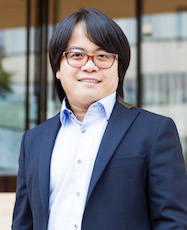
Pan Hui is Chair Professor of Computational Media and Arts and Director of the Center for Metaverse and Computational Creativity at HKUST (Guangzhou), and Chair Professor of Emerging Interdisciplinary Areas at HKUST. A globally recognized expert in ubiquitous computing and AR/VR, he is a Fellow of the Royal Academy of Engineering and IEEE, and a Member of Academia Europaea, and an ACM Distinguished Scientist. He has held prominent roles in both academia and industry across Europe and Asia, including Distinguished Scientist at Deutsche Telekom Laboratories and Nokia Chair in Data Science at the University of Helsinki. In addition to his academic accomplishments, Hui is a founding member of the INTEPOL Expert Group on Metaverse and a former member of the World Economic Forum Global Future Council on the Future of Metaverse. He received his Computer Science PhD from University of Cambridge.