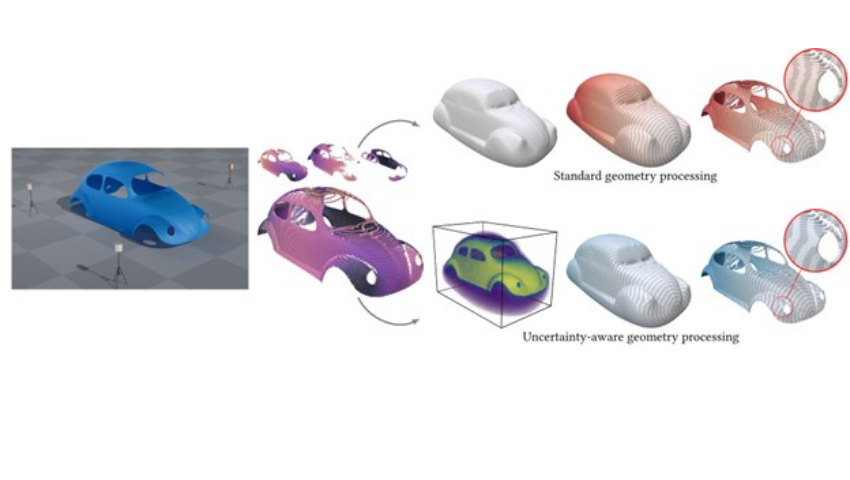
Image credit: Baptiste Genest and David Coeurjolly, Uncertainty-aware geometry processing on Gaussian Process Implicit Surfaces, (SIGGRAPH 2026/ACM TOG) 3D model from the Aim@Shape repository
In this SIGGRAPH 2026 Technical Paper, Baptiste Genest and David Coeurjolly introduce a framework for geometry processing on Gaussian Process Implicit Surfaces (GPIS), bringing uncertainty-aware versions of core operators like the gradient, divergence, and Laplacian into a probabilistic setting. By combining tools from differential geometry, scientific computing, and the Kac-Rice formula, their approach opens the door to computing directly on shapes that are noisy, incomplete, or only partially observed. Read more about “Uncertainty-Aware Geometry Processing on Gaussian Process Implicit Surfaces” to learn what you can expect from SIGGRAPH 2026 Technical Papers content.
SIGGRAPH: What motivated you to move beyond deterministic mesh- and point-based representations and explore geometry processing on probabilistic surfaces like GPIS?
Baptiste Genest and David Coeurjolly (BG and DC): This work was originally motivated by the scientific project that funds Baptiste’s PhD, named “Stable proxies”. This project aims precisely at developing robust methods to perform geometry processing on shapes that are noisy and/or only partially observed.
The idea of working from a stochastic view on the possible shapes given a noisy input was inspired by the SIGGRAPH Asia 2022 paper “Stochastic Poisson surface reconstruction” by Silvia Sellán and Alec Jacobson. Generally speaking, GPIS appear as a promising way to represent geometry as they are widely used in robotics and draw more and more attention in the computer vision and rendering communities. Their core appeal, that enabled this work, is that they are based on Gaussian distributions which drastically simplifies their study and usability.
SIGGRAPH: Your work considers uncertainty-aware analogs of core differential operators such as the gradient, divergence, and Laplacian. Did you face any challenges when defining these operators over a distribution of surfaces?
BG and DC: Those differential operators are fundamental objects in many areas of mathematics, with a long tradition in the geometry processing community. Hence, defining a meaningful and coherent set of analogs for this specific GPIS setting was the main challenge. We could derive the Laplacian by exploiting its connection with the Dirichlet energy, an also widely used construction in geometry, that was more easily generalizable on probabilistic surfaces. From this object, deriving the right construction for the divergence and gradient operators was also non-trivial, as other approaches could have been natural.
SIGGRAPH: A key component of your framework is the use of the Kac-Rice formula to embed surface computations into a volumetric domain. Explain how this insight simplifies or enables practical computation versus working directly on random surfaces.
BG and DC: Finding the Kac-Rice formula was a key moment in this project as it provided a strong theoretical ground to rely on for the rest of our work. At its core, our approach is based on computing the expected value of common geometric energies, expressed as integrals, (like the aforementioned Dirichlet energy) over all the possible realizations of the unknown shape. A naive approach to estimate this expected value of integrals would have been to draw a random surface from the shape distribution, evaluate the value of the integral, and average the result over many draws, only to end up with a noisy estimator of the true expected value.
The Kac-Rice formula essentially allows us to drastically simplify this estimation by giving a much simpler quantity to estimate everywhere in our discrete volumetric domain without having to draw entire surfaces.
SIGGRAPH: How does your approach change the way we think about noise and ambiguity in geometry processing pipelines, especially compared to traditional methods?
BG and DC: In standard geometry pipelines, noise and uncertainty are typically the first things you get rid of. The line of work in which we operate does the opposite: Knowing that there is noise or that a part of the shape is missing is considered as valuable information. That is preserved in the computations and affects the downstream applications.
SIGGRAPH: What types of applications or tasks can benefit most from uncertainty-aware geometry processing? Can you share any compelling examples?
BG and DC: We believe that the ideas developed in this work could be used, or inspire a solution, any time you want to perform a computation on a geometry that you cannot trust at 100%, either because some noise occurred or if some part of the shape has not been captured. Essentially, the framework we propose gives a natural answer, that accounts for uncertainty, to geometric problems once you have incorporated the range of reasonable geometries of your object in a GPIS model that is adapted to your setting.
SIGGRAPH: Looking forward, how do you envision this framework influencing future research at the intersection of geometry processing, probabilistic modeling, and PDE-based methods?
BG and DC: We hope that our work will inspire others to work with GPIS and, in particular, to look at them from the lens of scientific computing and differential geometry. To the best of our knowledge the Kac-Rice formula has not been used as a way to perform computations before and appears to be extremely useful when dealing with GPIS in general.
If you are interested in learning more about this research, be sure to register for SIGGRAPH 2026 and attend the Papers Fast Forward and Technical Papers sessions. Check out all of the Technical Papers content you can expect at SIGGRAPH 2026 on the full schedule now.

Baptiste Genest is a PhD student supervised by David Coeurjolly at the Lyon 1 Université, France, where he also studied computer science and applied mathematics. His research interests concern primarily optimal transport and geometry processing. He received best paper awards at Eurographics 2024 and SIGGRAPH Asia 2025.
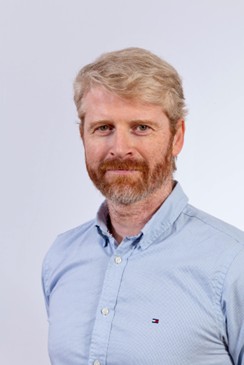
David Coeurjolly graduated from the Ecole Normale Superieure and the Université Claude Bernard of Lyon, France, in 2000 and received the Ph.D. Degree in digital geometry in 2002 from the Université Lumière Lyon 2. In 2003, he obtained a permanent research position (Chargé de Recherche CNRS) in the LIRIS laboratory, CNRS UMR 5205 Lyon. In 2011, he got a tenured Senior researcher position (Directeur de Recherche CNRS) at the same institute. In 2009, he received a Bronze Medal from CNRS that recognized his activities in Digital Geometry. Since 2022, he has been head of the GdR IG-RV (CNRS Research Network in Computer Graphics, Geometry processing and Visualization). Since September 2022, he is General Chair of the Graphics Replicability Stamp Initiative (http://www.replicabilitystamp.org). His present research interests include geometry processing, digital and computational geometry, Monte Carlo rendering and computer graphics.
David Coeurjolly headshot image credit: copyright Xavier PIERRE/CNRS