Image credit: Walt Disney Imagineering
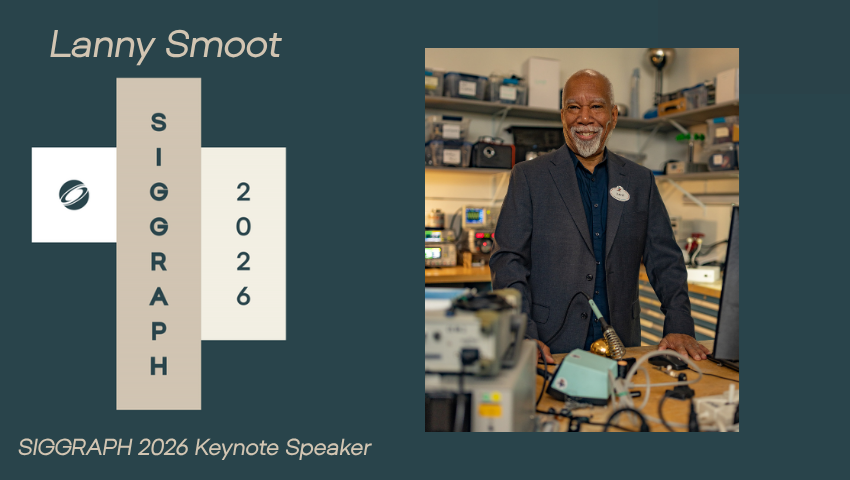
Lanny Smoot embodies the creative curiosity and technical ambition that define SIGGRAPH. With more than four decades of invention spanning fiber optics, immersive media, and iconic Emerging Technologies projects, Smoot’s work lives at the intersection of engineering, imagination, and storytelling. From early breakthroughs at Bell Labs to unforgettable experiences created at Walt Disney Imagineering, his journey reflects a deep belief that invention is a team sport. As the SIGGRAPH 2026 Keynote Speaker, Smoot brings a perspective shaped by 107 patents, a National Inventors Hall of Fame induction, and a lifelong joy in turning bold ideas into real‑world impact.
SIGGRAPH: SIGGRAPH 2026 is thrilled to welcome you as a Keynote Speaker. Looking back on your 45+ year career, was there a single moment or project that truly changed how you thought about invention and innovation?
Lanny Smoot (LS): Looking back on my long career in engineering and invention, the first shiver of excitement for me was for two of my early patents at Bell Labs. Back in those days (1970s), fiber optic transmission was just beginning to enter the telephone network and had the potential to open a new world of high-bandwidth transmission over long distances. Early systems used optical transmitters and receivers that had to be housed in temperature-controlled cabinets and were fragile. The receivers were not particularly sensitive, so expensive lasers were used to get enough power into a fiber so that a receiver miles away could obtain the signal. If the distance between the transmitter and receiver was too short, the receiver would be overloaded and unable to discern the signal.
My two patents provided a very sensitive optical receiver with automatic gain control (AGC). It could be used with inexpensive LEDs which put out much less light and the receivers AGC could not be overloaded at any length. My systems worked in all environments and were economical enough to enhance the growing use of fiber optic transmission across the country.
Even as a youngster, I was always “inventing,” but these early patents thrilled me as I realized that I could personally help change (at least a small part of) the world!
SIGGRAPH: Many of your inventions blend engineering, illusion, and storytelling. What have you learned about building effective teams made up of radically different disciplines?
LS: I am a huge believer that engineering and invention is a team sport. There are all kinds of engineering specialties — mechanical, electrical, chemical, optical, computer, and materials, to name a few. Modern products require many different skill sets to come to market, but I have seen no better example of the need for collaboration as when I joined Walt Disney Imagineering at the Walt Disney Company.
I always joke that the things I design or build in electronics, optics, and mechanics will work; however, they may not be “pretty.” I have the luxury to be working with some of the most talented artists and aritisans in the world and the best storytellers in the business. Where I am weak, another is strong, and I believe that we are all most efficient if we work in the areas that we are strongest. We then have to think about the “edges” between the fields. For success, you have to know enough about your teammates’ fields, and their problems, and vice versa, so that you can communicate a problem in their language. Ideas woven together make large, successful, projects come to fruition.
SIGGRAPH: Being inducted into the National Inventors Hall of Fame (NIHF) alongside Walt Disney is extraordinary. What did that moment mean to you personally?
LS: This is a great question for me. Receiving the NIHF recognition was an amazing honor, and I did not know whether any other Disney employee had ever received it. When I learned that Walt was the only other person, I became a little emotional, and the depth of the honor struck me to the core. Before the major celebration at the United States Patent and Trademark Office, an inductee places a special name badge on a “Wall of Inventors”. To know that Walt’s pin was also there was surreal.
SIGGRAPH: With 107 patents to your name, how do you recognize when an idea is worth pursuing versus when it should stay on the drawing board?
LS: I love inventing and coming up with new ideas. To be a successful inventor one has to be a realist and your own toughest critic. Is this idea really new? Become familiar with the field and ultimately do a patent search!
Be honest about the importance of the idea and whether it will be used and/or enjoyed by large numbers of people (not just you). Is the idea worth the time and effort — especially if you’re a team leader?
Financial reality: Companies want to make a profit, and they deserve a part of that profit if you’re using their resources.
If we can’t see strong vectors in all directions, it’s time to move away from the idea. If, and only if, all is good, I get my partners and go to work!
SIGGRAPH: At SIGGRAPH, your Emerging Technologies projects, like the Holographic Zoetrope, have become legendary. What role has SIGGRAPH played in shaping or accelerating your ideas?
LS: I believe that successful technical practitioners love to create and want to learn from others who have new ideas that might fill the gaps in the dreams that they have. There is one other strong motivation, and it is the desire to show off a latest brainchild but with a gentle human competitive spirit that ends with comradery. Each time that I have made a contribution to SIGGRAPH, I have taken home more than I have given.
SIGGRAPH: From early video-on-demand systems to holographic and immersive environments, what patterns do you see repeating as new technologies emerge?
LS: New ideas always go through repeating patterns, with future impacts underestimated. When optical fiber entered the telephone network, it was thought of as a way to connect more telephones. Only a few knew that we would sit at home and watch media (and each other) from around the world instantaneously. When computers were developed for the home, they were thought to be able to keep track of kitchen food recipes. AI has likely been underestimated, and hopefully like all new technologies, it will change and enhance our lives much more than we think. Also, hopefully not with the draconian endings that could occur, but … it’s up to us.
SIGGRAPH: What is one key takeaway you hope SIGGRAPH 2026 participants uncover from your keynote, “Inventions, Innovations, and Imagination: Lanny Smoot’s Prolific Path”?
LS: Actually, I hope several things: For the younger folks in the audience, I would like them to know that they can have great joy in being an inventor. We don’t have to be experts in all technical (or artistic) areas, as it is teams of people with different strengths who are most likely to do amazing work. For the experienced technical practitioner: Enjoy the friendly competition to create new technologies … we technologists are a very important part of society and we are often in the lead in how the world can be made a better place.
Are you ready to get a look into the joys of being an inventor and the excitement of creating new technologies? Register for SIGGRAPH 2026 so you don’t miss a moment of the new technology and ideas on display, including Lanny Smoot’s keynote.
Lanny Smoot (Research Fellow, Disney Research) has spent more than 45 years as a theatrical technology creator, telecommunications systems researcher, inventor, electrical engineer, and scientist — with 25 of those years at The Walt Disney Company. Lanny holds Bachelors and Masters degrees in electrical engineering from Columbia University and he has invented and patented many forward-looking technologies that allow The Walt Disney Company and, ultimately, the theatrical community at large to create new magic, illusions, and entertainment. With 107 patents to his name, he is Disney’s most prolific inventor. His work can be seen throughout Disney’s theme parks, resorts, and cruise ships worldwide.

Lanny joined Walt Disney Imagineering as the head of its Research & Development site in East Hampton, New York, and moved with that group to the Los Angeles Imagineering R&D headquarters a few years later. He joined Disney Research (the most forward-looking part of Research & Development) and became a Disney Research Fellow in 2014.
Seventy-five of Lanny’s patents are from his research and inventions at Disney. Some of Lanny’s early patents and innovations there include “Where’s the Fire?” at Innoventions, formerly at EPCOT; classic special effects guests love in the Haunted Mansion; the virtual interactive koi ponds at the Crystal Lotus Restaurant at the Hong Kong Disneyland Hotel; the Fortress Explorations interactives at Tokyo DisneySea; and “Power City” at Project Tomorrow. More recently, he has created state-of-the-art extendable lightsabers along with the high-tech interactive lightsaber training experience used at Star Wars: Galactic Starcruiser at Walt Disney World. He and his team have also created the HoloTile™ Floor, an omnidirectional treadmill, allowing persons on it, wearing head mounted displays, to walk through surrounding virtual environments.
Before Disney, Lanny worked at Bell Labs and then at Bell Communications Research (where he was also that company’s patent leader). While at Bell, Lanny earned patents on early video-on-demand technology, video conferencing, and television systems allowing viewers to individually choose their gaze direction from a special camera.
Lanny is the recipient of numerous awards and honors, including three Thea Awards from the Themed Entertainment Association (for Finding Nemo Submarine Voyage at Disneyland Park, Kim Possible World Showcase Adventure at EPCOT, and the “Ghost Post” limited time experience inspired by the Haunted Mansion). Additionally, he was named a 2020 TEA Master, also by the Themed Entertainment Association.
Lanny was inducted into the National Inventors Hall of Fame® in the class of 2024 and is only the second person from The Walt Disney Company to achieve this honor. The first was Walt Disney, honored posthumously in 2020 for the invention of the multiplane camera. Lanny was featured as part of the exhibit “Breaking Barriers: Honoring Extraordinary Black Inventors” at the National Inventors Hall of Fame® Museum located in the United States Patent and Trademark Office headquarters in Alexandria, Virginia. The NIHF exhibit is being presented in partnership with the USPTO and the Black Inventors Hall of Fame.
Beyond his own achievements, Lanny feels a responsibility to help others recognize and magnify their own talent and creativity. He has often spoken at schools from the university level to grade schools to encourage young people, especially people of color, to consider careers in the sciences and themed entertainment and he has mentored dozens of young people over the years, almost all of whom have gone on to successful careers at The Walt Disney Company and elsewhere.