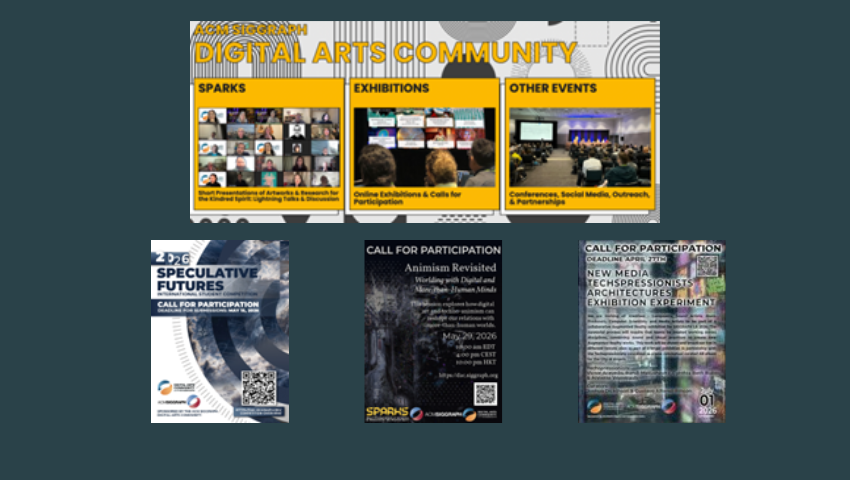
Image credit: A selection of upcoming events’ social media graphics from ACM SIGGRAPH DAC website
By Gustavo Alfonso Rincon and Rebecca Xu
Since SIGGRAPH 2025 in Vancouver, the ACM SIGGRAPH Digital Arts Community (DAC) has continued to build momentum, expanding its role as a year-round platform for dialogue, experimentation, and collaboration in digital art. As we look ahead to SIGGRAPH 2026 in Los Angeles, DAC’s activities reflect an ongoing commitment to connecting artistic practice with research, technology, and critical discourse.
At the time of writing, several initiatives are simultaneously unfolding. The 2025–2026 SPARKS (Short Presentations of Artworks & Research for the Kindred Spirit) series, led by Bonnie Mitchell, is nearing completion, bringing together artists, researchers, and technologists through accessible online conversations. The third Speculative Futures International Student Competition is underway, inviting emerging voices to imagine alternative trajectories for art and technology. In parallel, new exhibitions are in development, extending DAC’s curatorial work beyond the conference itself.
Led by Rebecca Xu, DAC continues a legacy established by founding members Jacquelyn Ford Morie and Masa Inakage in 2004. This mission emphasizes year-round engagement across digital, electronic, computational, and media arts through artist-led conversations, hybrid programming, and curatorial platforms that connect art, research, and technology. Rather than positioning art as an outcome, DAC frames it as a process of inquiry that supports interpretation, experimentation, and exchange.
From our perspective as DAC committee members, this work becomes tangible through curatorial and organizational roles. Both of us have contributed to exhibitions, both online and physical, and co-organized and moderated SPARKS events. These efforts are less about logistics and more about shaping contexts where ideas can circulate across disciplines. DAC operates as a connective structure, linking academic research, artistic practice, industry experimentation, and student exploration, while engaging the SIGGRAPH community both creatively and intellectually.
A key aspect of this work is outreach. Through SPARKS events, open calls for participation, and curatorial initiatives, DAC members actively identify and support emerging voices across regions and disciplines, cultivating a distributed and evolving community. In Gustavo’s own role, he approaches curatorial work, event organization, and social media outreach as forms of advocacy, connecting with new members and helping shape the next generation of leaders in our field.
Looking ahead, DAC’s programming continues to expand. The April SPARKS, “Confluence of Generative AI and the Art of Filmmaking,” moderated by Sal Ardongdé, focuses on innovations in the field and the upcoming May SPARKS “Animism Revisited: Worlding with Digital and More-than-Human Minds” takes a more thematic approach. In June, Rebecca Xu will host the SIGGRAPH 2026 Creative Content Sneak Peek, providing a preview of this year’s conference, extending the conversation beyond the conference timeline.
At SIGGRAPH 2026, DAC will collaborate closely with the Art Gallery and Art Papers programs, hosting an award reception, a roundtable session, and a social gathering. One highlighted initiative, “A New Media Techspressionist Architectures — AR Experiment,” co-curated by Joshua Dickinson and Gustavo Rincon, is conceived as a form of local community engagement in Los Angeles. Featuring artists including Victor Acevedo, Randi Matushevitz, Cynthia Beth Rubin, and Annette Weintraub, and opening at the Los Angeles Center for Digital Art (LACDA) on 1 July, the project extends DAC’s presence into the city’s cultural ecosystem. By situating this work within a local context, it creates opportunities for exchange between Los Angeles-based communities and the broader international SIGGRAPH network.
What emerges across these efforts is a model of community that is distributed, interdisciplinary, and participatory. DAC is not defined solely by its events, but by the relationships and exchanges those events make possible.
As we gather this summer in Los Angeles, we invite you to take part in this ongoing process. Whether as an artist, researcher, student, or collaborator, DAC offers not just a platform for presentation but a space for co-creation, where ideas are tested, perspectives are expanded, and new directions for digital art are collectively shaped.
Join us.
ACM SIGGRAPH Digital Arts Community: Rebecca Xu, Victoria Szabo, Bonnie Mitchell, Jan Searleman, Johannes DeYoung, Melentie Pandilovski, Gustavo Alfonso Rincon, and Sanglim Han