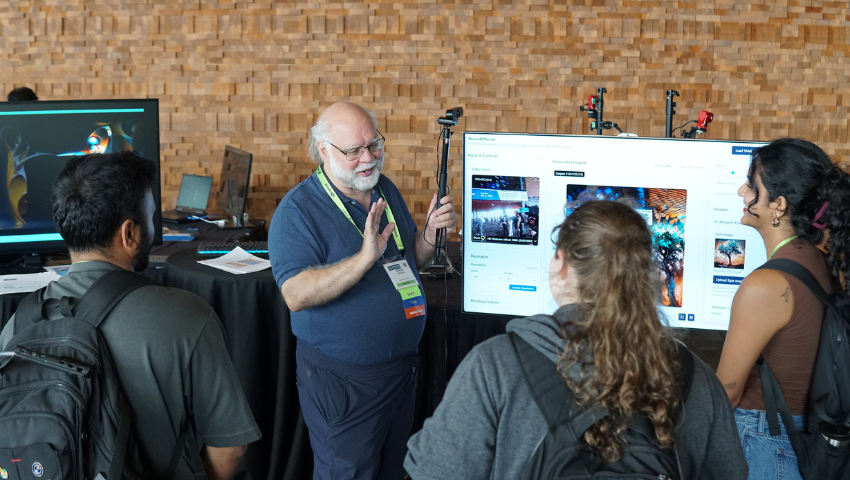
Image Credit: photo by David Weng © 2025 ACM SIGGRAPH
As SIGGRAPH 2026 heads to Los Angeles, two programs are helping define how the community explores both emerging ideas and interdisciplinary connections. We spoke with Adam Bargteil, Technical Workshops Program Chair, and Erik Brunvand, Frontiers Program Chair, about what inspires them about their programs this year, how contributors can find the right fit for their work, and what attendees can look forward to at SIGGRAPH 2026.
SIGGRAPH: With Frontiers being a long-standing program at SIGGRAPH and Technical Workshops being newer to the conference, can you each share some brief insight into your programs? What inspires you about your program ahead of this year’s event in Los Angeles?
Adam Bargteil (AB): I think one of the coolest ways to think about the Technical Workshops program is how it complements the Technical Papers program. Both share the same level of technical rigor, but while Technical Papers is comprised of sessions of loosely related papers that were accepted by the program committee, the organizers of Technical Workshops are able to thoughtfully curate and assemble the program. The organizers could structure the workshop to look at the same problem from different angles, building insights and connections throughout the session that can be highlighted at the end; or they could organize the workshop to start with a broad overview of a problem and then dive ever deeper into a particular aspect. This holistic approach to organizing Technical Workshops is really key to the experience. Of course, all of this holds true for Frontiers Workshops as well.
I am still in awe of how successful the Technical Workshops pilot was in 2025. I have had a sense that the SIGGRAPH community wanted a Technical Workshops program for some years now, but I dramatically underestimated how enthusiastically the program would be received. We should have booked a larger room! 🙂
For 2026, I am really looking forward to seeing the program expand and seeing how the organizers experiment with the format. Like anything in a nascent stage, it is difficult to predict exactly what it will become, but it is also really exciting be on the journey to find out.
Erik Brunvand (EB): The Frontiers program is one of my favorites at the conference. As the name implies, it consists of talks and workshops that are at the frontier, the edges, of computer graphics and interactive techniques. This idea of being “at the frontier” gives me a wide latitude of topics to think about and enables topics that are not things that you would likely find in other SIGGRAPH programs. This is the reason that it’s one of my favorites — I’m a very curious person and really appreciate hearing about interesting topics that I may not have been very familiar with. I’m a big believer in the power of interdisciplinary thinking and believe that really interesting ideas often come from collaboration and from thinking about things from a different perspective. Frontiers Talks and Workshops are an opportunity to hear from, interact with, and explore synergies with experts in other fields.
I’m reminded of a comment about Pixar’s new headquarters in Watsonville, California. Ed Catmull had this to say about the building1: “Our building, which is Steve Jobs’s brainchild, is another way we try to get people from different departments to interact. Most buildings are designed for some functional purpose, but ours is structured to maximize inadvertent encounters. At its center is a large atrium, which contains the cafeteria, meeting rooms, bathrooms, and mailboxes. As a result, everyone has strong reasons to go there repeatedly during the course of the workday. It’s hard to describe just how valuable the resulting chance encounters are.”
SIGGRAPH Frontiers is, I hope, one of those places that attendees can go for valuable encounters with thinkers in other disciplines.
1 https://hbr.org/2008/09/how-pixar-fosters-collective-creativity
SIGGRAPH: What advice can you share with contributors who are unsure if their work belongs with the Technical Workshops program or the Frontiers program?
AB: I think maybe the easiest way to think about the distinction between Frontiers and Technical Workshops is the intended audience. If the audience is more or less the same as Technical Papers, then it is probably a Technical Workshop; if the audience is more general, like “everyone at SIGGRAPH”, then Frontiers Workshops is likely a better fit. This distinction is also reflected in the registration levels: Technical Workshops require Full Conference while Frontiers Workshops are open to Experience badge holders.
EB: One view of Technical Workshops is that they involve topics that are emerging, and that may still have fascinating room for extension and refinement, but that are recognizable topics to a SIGGRAPH technical audience. The presenters are likely already familiar with our conference and are looking forward to engaging with SIGGRAPH attendees.
Frontiers topics may also be emerging, or they might be well-studied, but they are not something where the presenters necessarily would have even thought to submit to SIGGRAPH. So, it’s my job to reach out and invite these speakers to SIGGRAPH and help them see how their work can be framed as being at the frontier of our disciplines. Hopefully, SIGGRAPH attendees will agree that Frontiers topics are as interesting as I think they are!
SIGGRAPH: Are there specific areas or disciplines where you’d especially like to see more contributions this year?
AB: I would like to see one or more of last year’s workshops come back for a second iteration; I would like that to be established as a precedent going forward, that workshops can repeat. To be clear, I do not mean duplication, but rather the workshop format naturally lends itself to variation. The same topic explored by different speakers will be a very different experience and that is super cool.
As program chair, I am pretty agnostic as to particular topics; I would like to see breadth and variety. I am most excited about topics that are just beginning to come into focus, where there are real open questions, and SIGGRAPH needs to debate visions of the future. These might be areas where we are just starting to see Technical Papers and where having 75 people spend half a day thinking really hard could provide a turbo-boost to propel the field forward.
EB: It’s unlikely that most Frontiers presenters already know about, or would think about submitting to SIGGRAPH. So, the contribution areas are a bit up to me as the Frontiers Chair. I’m taking a fairly expansive view of “the frontier” as it relates to our conference topics, so expect to see a nicely wide-ranging program. I’m also thinking of ways to tie into our conference location in Los Angeles this year.
SIGGRAPH: What common pitfalls should potential contributors avoid in their submission materials?
AB: I encourage anyone thinking about submitting who has any questions or wants any advice beforehand to reach out. Unlike Technical Papers, Technical Workshops does not have an anonymous, rigorous review process. We are eager to help you prepare a stronger workshop proposal as that will lead to a stronger Technical Workshops program.
EB: Frontiers is largely a curated/invited program, but that doesn’t mean that interested speakers or workshop presenters can’t contact me with their ideas. Send me an email at frontiers-s2026@siggraph.org, and I promise to read, consider, and reply! If you are interested in proposing a talk or workshop, please keep the idea of “frontiers” in mind and help me understand why your idea is not only interesting in its own right, but has some (even peripheral) connection to computer graphics and interactive techniques. Help me understand why an attendee would get up to see an 8 am talk on your topic, or spend valuable conference time at your workshop.
SIGGRAPH: While submissions are still being accepted, what insights or news can you share with attendees as to what they can expect this year at your programs at SIGGRAPH 2026?
AB: We are hoping to have 10-12 Technical Workshops this year, roughly double the number in last year’s pilot. They will run Sunday through Thursday, possibly being front-loaded on Sunday to avoid conflicts with Technical Papers. This year, workshops can optionally include submitted content (e.g., sketches, posters, abstracts), which we hope will allow junior members of the community to participate in the program.
EB: I hope that you’ll find the Frontiers program as compelling as I will (I’m not planning on curating any content that I wouldn’t get up to see). These will be talks and workshops that are not core SIGGRAPH material, but hopefully you will find them interesting, informative, and perhaps they might even result in new collaborations or spark an investigation in an area that you weren’t familiar with before.
The Frontiers and Technical Workshops programs are actively accepting submissions! Visit our program submissions page and submit your work to be a part of computer graphics excellence at SIGGRAPH 2026.
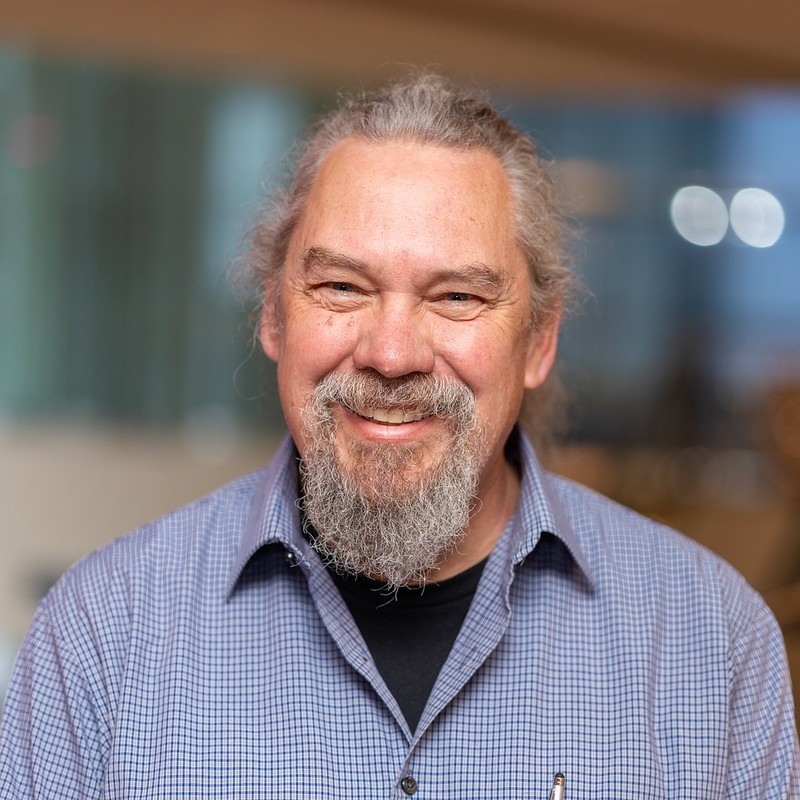
Erik Brunvand is a Professor in the Kahlert School of Computing at the University of Utah in Salt Lake City, Utah, where he has taught and done research for over 30 years. His research and teaching interests include the design of application-specific computers, graphics processors, ray tracing hardware and software, asynchronous systems, and VLSI. Brunvand and his students are currently designing a many-core computer architecture targeted at real-time graphics rendering using ray tracing.
He also has a strong interest in arts/technology collaborations in both education and research. He co-developed and taught a collaborative course with colleagues in the Art department at the University of Utah entitled Embedded Systems and Kinetic Art. This course pairs computer science and art students into teams to design and build collaborative computer-controlled kinetic artworks. He has also developed and taught a course on sound-art as an intro to technology through the lens of using sound as a medium for making art. As an artist, Brunvand is a printmaker, co-founder of Saltgrass Printmakers (nonprofit printmaking studio in Salt Lake City), and he also works in mixed-media computer-controlled kinetic arts.

Adam Bargteil is an associate professor in the Department of Computer Science and Electrical Engineering at the University of Maryland, Baltimore County. He completed his Ph.D. in computer science at the University of California at Berkeley and then spent two years as a postdoctoral fellow in the City of Bridges working in the Graphics Lab at Carnegie Mellon University. Before returning home to Maryland, he was an assistant professor in the School of Computing at the University of Utah.