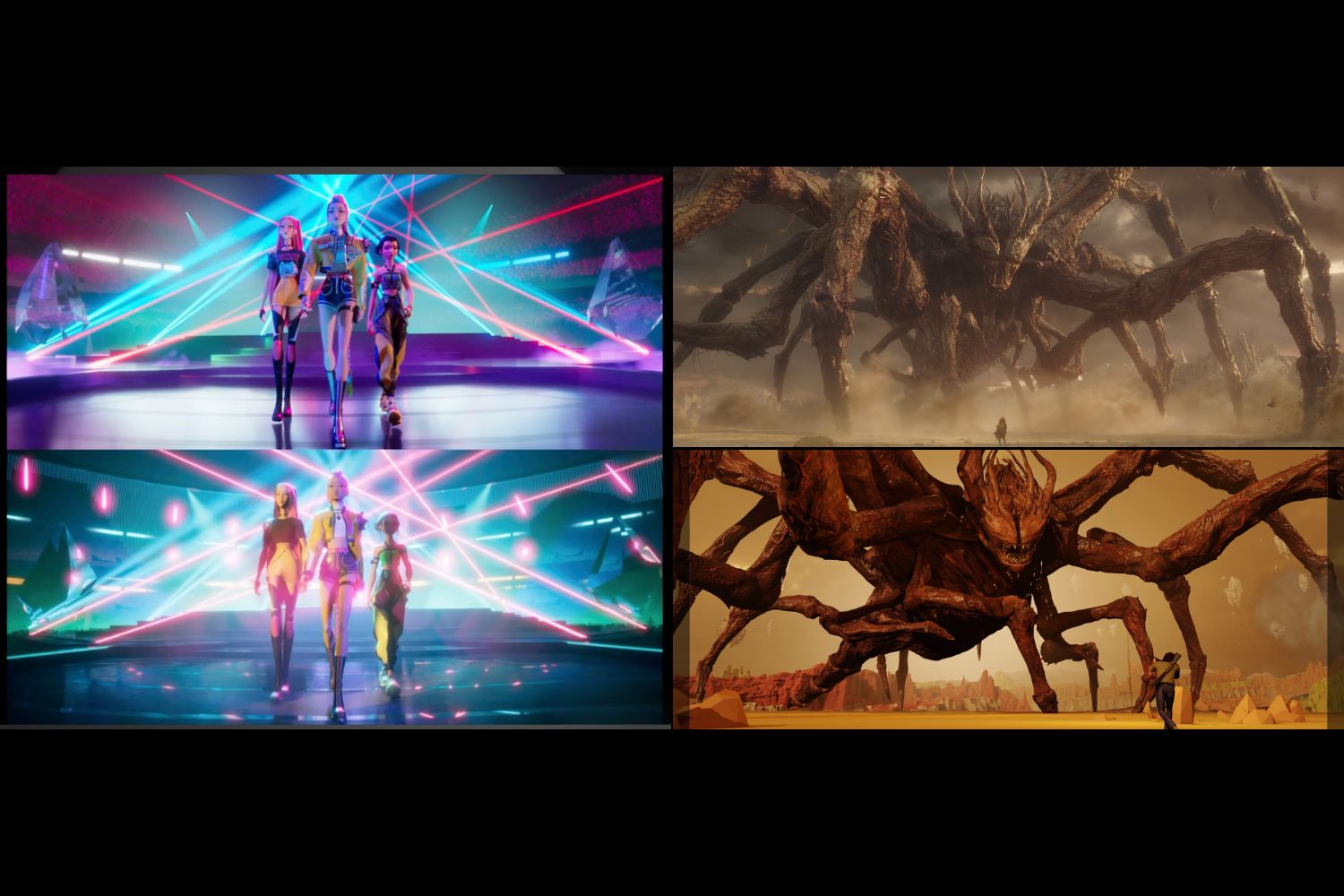
Image credit: © Netflix
Blog interviewee contributed to the “KPop Demon Hunters” portion of the session’s representative image.
The lines between animation, visual effects, and games continue to blur, and previsualization (previs) is evolving alongside them. What once served primarily as a planning exercise now helps shape creative decisions, pipeline strategies, and production outcomes at every stage of development. At the same time, advances in real-time technology are challenging long-held assumptions about how artists work, collaborate, and iterate.
Ahead of the SIGGRAPH 2026 Panel “The Previs Battleground: Precision Planning vs Creative Freedom,” panelist Adam Holmes shares insights from nearly three decades in computer graphics, reflecting on the changing role of previs, the promise of emerging tools, and the importance of balancing technical rigor with creative exploration.
SIGGRAPH: Previsualization (previs) has evolved from a planning tool into a core driver of production decisions. What are some of the most significant ways you’ve seen previs reshape the creative process in recent years?
Adam Holmes (AH): Previs for visual effects films has come a long way with the adoption of real-time software, custom toolsets and extremely talented artists. From what I’ve seen, the exponential increase in the quality of visualization has provided filmmakers with the ability to make more informed creative decisions, in context, with highly detailed characters, facial animation, motion capture, lighting, atmospherics, FX, destruction, virtual cameras, etc., and this plays more effectively in screenings and executive reviews.
The speed at which iteration and revisions can be made is also significantly faster, allowing for more options in less time — which ideally equates to better decision making overall.
If it wasn’t for George Lucas’s pioneering use of previs on the “Star Wars” prequels in 1999, industry adoption would probably have been much slower. I was fortunate to have worked at Lucasfilm Animation a decade later in the proprietary software and systems that grew from those films, and it was clear how applying a filmmaker’s approach to software and workflow is critical to the artist’s toolset. But cool software alone can’t help the sheer excitement and terror when George is over your shoulder directing your shots.
This same previs approach is being applied to CG films as well, on a different scale and longer timeline. Feeding a large pipeline of teams of animators, lighters, FX artists, and production coordination with more accurate visual information in the (cheaper) front-end, is making the production process on the (more expensive) back-end more cost effective. Fewer redo’s and less rework is always music to a producer’s ears!
As fast as the software has become, the desire to add more visuals inevitably creates more work for previs artists to manage day to day. It can be a delicate balance between adding visual bells and whistles and getting shots done on time — and in VFX, time is always in short supply.
The hardware component has also evolved quickly, with virtual cameras and controllers, mo-cap and markerless mo-cap options, LED walls and virtual production stages which allow access for on-set filmmakers to use familiar tools in a real-time virtual shoot setting. I think the blending of real-time-capable hardware with real-time software has opened up the doors to be more dynamic in a previs “shoot” environment where creatives aren’t restricted to waiting for an artist to keyframe action or a camera, and that real-time feedback is essential to the dynamic creative process that live-action shoots have always had the advantage of over CG.
There’s still a lot of room for improvement for larger facilities in setup and maintenance, the cost of space, networking, and compute, but those walls are starting to come down where a single artist can create an entire production with very little up-front cost.
SIGGRAPH: The panel highlights a tension between speed and fidelity. How do you approach balancing fast, exploratory previs workflows with the need for precision and downstream accuracy?
AH: I suppose there’s a Venn diagram for this: Speed, Fidelity (Pipeline), and Budget. I think a lot of productions are looking to see how they can optimize each of those areas, without sacrificing one or more. Sometimes these distinct workflows are oil and water, and we can accept that.
If you want to create pure previs, throw Pipeline out the window and treat the output as pretty pixels on the screen. Maybe it’s just to get a project green-lit, or maybe to pitch a really cool idea. Don’t let the pipeline decide how you work. Run and gun. Messy as you can handle. Save 1,000 versions with a few breadcrumbs, but keep moving forward at the speed of ideas.
Feeding a production pipeline is sometimes the opposite end of the spectrum. Exact models. Two or three bites at the “approval apple.” Creative iteration is limited by schedule and money spent. If the data fails going downstream, cue up the service tickets. The overlapping assembly line of huge teams can’t wait. Go time!
Scale is number one. Not the thing you curse every morning after stepping on it. Asset scale. If scale is in flux, so is every shot, every composition. If exploratory previs can help determine scale, shots can move into production with confidence. One of the most effective previs processes I had implemented for CG films at Imageworks was location scouting. Quick 3D storyboards with in-progress models and real lensing. Get that in front of the production designer and modeling team to know what not to build, save time and money and improve accuracy.
On “KPop Demon Hunters,” we leveraged Unreal Engine’s game mode to take this concept to a new level. We built tools to let artists literally walk, run, and dynamically pose a character, like a video game, while testing compositions using production lenses and in-progress models. Freeze a copy of the character and the camera and move on. Maybe a couch was too big, or a door frame was too small. This helped communicate what worked and what didn’t early on and reduced excess tickets to modeling during production.
Sometimes in the middle of production, a new idea or story problem needs solving and the mindset shifts from precision fidelity (pipeline) to what-ifs and see-what-sticks (previs). This is where adaptable artists and toolsets are critical. We designed flexible tools where freeform shots with overlapping camera coverage, like a stage play, can feed editorial footage when needed, or precise shot timings matching an Avid reference.
Even in the “old days” (like eight years ago old, before real-time previs) I was supervising layout on Glen Keane’s “Over the Moon” and one part of a key sequence just wasn’t landing. So, we “paused” shot layout and started blocking out some new action using some Post-It sketches he drew and we screen-grabbed them from the Zoom call. We played with a bunch of fun cameras, which also got our creative juices going, and we got even more fun ideas … Then we mocked up a test edit to pitch the shot progression and sent editorial a bunch of raw footage. The process really worked. Glen lit up when he saw his vision for the sequence more fully realized. Because we all agreed it was worth the extra time to play, the film was better off as a result. We published those shots into animation with the precision and confidence needed to keep production on track.
SIGGRAPH: As pipelines converge across animation, VFX, and games, previs is being asked to serve multiple roles. Where do you see the biggest challenges — or opportunities — in adapting workflows across these disciplines?
AH: I see challenges in this area if implementing the best workflow for each use-case isn’t the primary driver. Trying to create an uber-tool will fail — where would you even start? There’s inherent cross-over for sure, and cameras are the universal constant. Their creative use in each of those disciplines can vary widely, and therefore the tools to create and deliver a camera for each can be different. And the downstream receiver will need a camera format that works in each pipeline.
Games cameras run in real time, reacting to the character or controller, but also deliver pre-built cinematics. VFX is driven by live-action plates, post-vis, tech-vis, shot blending, and retimes. CG animation is more and more tied to realistic live-action cinematography logistics, virtual cameras, and yet can take cues from games and VFX.
So, I think the opportunity is to look at how you’re solving the unique problem presented by the creative intent and ask yourself (and your team): Do we need specialized tooling to scale across the show? Let artists drive the process and adapt tooling along the way for better efficiency? I find the latter may push out development time, but it will yield the best long-term results. Over-engineering it from the start can paint you into a technical corner, if the code is too specifically tied to each task.
At its core, previs is attempting to bring creative decisions into focus, managing complexity and cost, while providing a technical blueprint for subsequent departments to follow, along with a rough visual road map that clients can understand and react to, no matter the core entertainment vertical you’re in.
SIGGRAPH: With real-time tools becoming more embedded in production, how do you see previs evolving in the next few years — particularly in terms of creative iteration and collaboration?
AH: We’re living in interesting times when it comes to trying to predict how tools and workflows will evolve. My opinion today will be different tomorrow — that’s how quickly the ground is shifting beneath the industry. There’s a lot of sparkles and magic surrounding generative and agentic integration with the popular DCC’s, real time and offline. But if the exact artistic vision can’t be realized any faster, and I can’t get a shot approved by pulling the slot machine handle of infinite iteration, what’s the point?
It depends on the purpose and use-case. Iteration early on with a rough idea and rough designs? Pull that lever with some artistic input and direction and you can quickly tell what isn’t going to work. Which is just as important as getting the result you want.
I want a tool that gets what’s creatively in my head, onto the screen, keeping all the data editable with precision control over time and space, and lowers the friction between my intent and the pixel. If I don’t need to memorize a complex series of mouse and keyboard interactions with menus, settings, and variables but I still can if I need to, then we have the best of both worlds. Rapid ideation with direct creative guidance only an artist can give.
Maybe kitbashing can be less labor intensive with words and scribbles, and AI could swap out real production models when they’re ready. Maybe a complex camera move can start out as a sketch with a series of scouting snapshots and generated real time via a training model of real-world data, shaky imperfections and all, with precise control over speed, weight, and composition.
I’d love to see the evolution of 2D client notes during reviews translated into modifying the 3D scene in real time. Reduce the loop of get the note, do the note, show the note, then get a new note. Interactive workflows in real time software can do this, but it’s still labor intensive. And clients may not have the time nor patience for the old move, rotate, scale, repeat dance … even if your scene runs at 60 fps.
SIGGRAPH: What makes SIGGRAPH an important space for conversations about previs and production workflows at this moment in the industry?
AH: SIGGRAPH is exactly where these conversations should take place, sparking lively debate and exchange of opinions, workflow ideas, and, most importantly, war stories from the front lines of production. This is how we evolve the industry: Together in conversation. Not just toiling away on our keyboards in solitude. There’s no perfect tool, workflow, or pipeline, but exposing yourself to as many of those as possible will spark new ideas and solutions.
At the core of the conversation should always be “why.” Cut through the hype and demo magic. How will this rapidly evolving technology actually integrate into creative decision making and technical problem solving? Does it provide our clients a better experience day to day, or daily frustration? Will it scale across multiple platforms, projects, and teams, or is it a one-off you’re re-coding next year (vibe or traditional)? Working in CG feature timelines, we think a bit further out and how implementing technology will help or harm completing the production to our own and our client’s standards.
SIGGRAPH: What do you hope attendees take away from this discussion, especially those navigating similar trade-offs in their own work?
AH: I hope that anyone entrenched in their specific tool or workflow is challenged to consider new ideas, and to experiment with at least one area they were hesitant to, prior to this discussion. And take that new mindset back to your studio and challenge colleagues, your boss, your teammates with the same. Make a point to engage your teams in challenging what’s possible; however small can make a big impact. Encouraging opportunities for collaboration and new approaches creates trust and a stronger team overall.
Interested in attending “The Previs Battleground: Precision Planning vs Creative Freedom,” or exploring other Panels? Be sure to register for SIGGRAPH 2026 and view the full schedule to see what else awaits this year’s attendees.

Adam Holmes is Head of Visualization at Sony Pictures Imageworks based in Vancouver BC, and leads a team of 60+ Layout artists on award winning CG and VFX films. For over a decade at Imageworks, he has supervised Camera & Layout on films such as The Sea Beast, Over the Moon, Ant-Man Quantumania, The Meg, and Smallfoot.
Since 2023, Holmes has led development efforts at Imageworks for real-time creative technology alongside R&D teams with a focus on cinematic workflows in pre-production. Debuting Unreal Engine on the Oscar-winning film KPop Demon Hunters unlocked exciting real-time collaboration in previs and camera layout for the filmmakers and artists.
Prior to Imageworks, Holmes was a previs supervisor at film studios including Digital Domain (Thundercats), Frantic Films (Superman Returns), Digital Dimension (Elf), and Imagi Studios (TMNT, Gatchaman, Astro Boy), and as a senior previs artist on Rainmaker’s Ratchet & Clank film adaptation and George Lucas’ CG feature, Strange Magic.
After graduating from film school in Chicago, Adam began his CG career in 1996 on the “Veggie Tales” series. A few years later, he served as a global 3D product specialist for Discreet/Autodesk, supporting diverse clients in architecture, film, games, and post-production.
Randomly, he was cast as an announcer in an unreleased Chris Rock music video.
Intentionally, he is learning to DJ.
Watch the Epic Games Spotlight video on Imageworks and Kpop Demon Hunters on YouTube.