photo by Cabe Tejeda © 2026 ACM SIGGRAPH
By Victoria Szabo and Gustavo Rincon
New Media Techspressionist Architectures
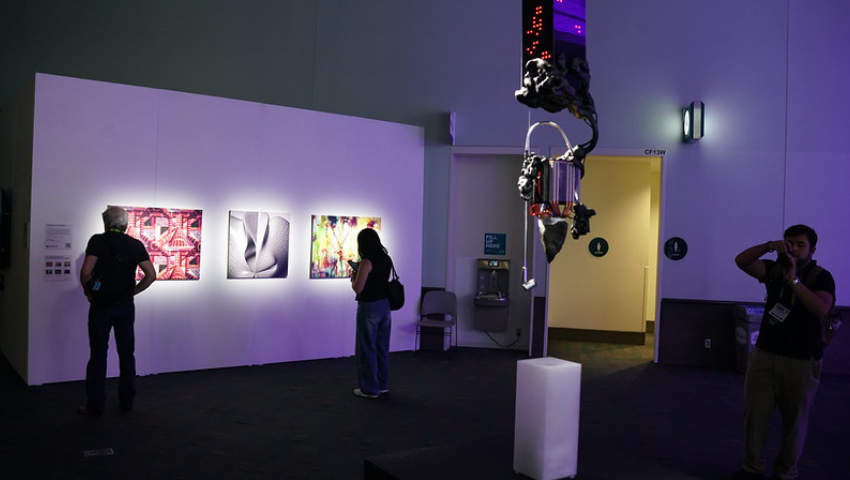
In the summer of 2026, as part of SIGGRAPH 2026 in Los Angeles, ACM SIGGRAPH DAC, Techspressionist Artists, and LACDA presented six collaborative works bringing together artists, composers, and technologists. As a continuation of the New Media Architectures (NMA) exhibition series, the project explored augmented reality, sound, and interactive media to connect physical and digital environments. This curatorial event was co-organized with Joshua Dickinson, Tuna Bora, and Randi Matushevitz.
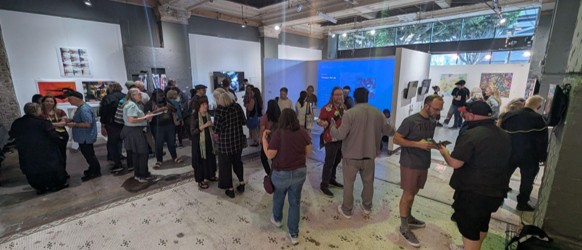
Photos provided by ACM SIGGRAPH DAC. New Media Techspressionist Architectures exhibitions at SIGGRAPH & LACDA
The Idea
Using Los Angeles as a living laboratory, the exhibition examined how AI, data, and algorithmic spatial infrastructures can potentially transform contemporary urban life. Framed through Techspressionism and New Media Architectures, the project used space as a creative medium where physical, digital, and sonic realities converge. Through sound, image, and emerging technologies, participating artists explored new forms of performative expression and computationally mediated experiences.
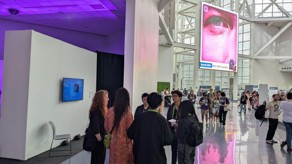
Photos provided by ACM SIGGRAPH DAC. New Media Techspressionist Architectures exhibitions at SIGGRAPH & LACDA
The critical inquiry was informed by a close reading of Andrew Culp’s “Dark Deleuze”, inspiring an examination of perception, simulation, materiality, networks, algorithms, and the increasingly synthetic social infrastructures shaping contemporary life.
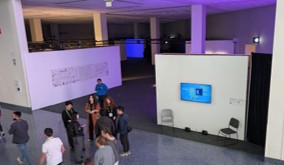
Photos provided by ACM SIGGRAPH DAC. New Media Techspressionist Architectures exhibitions at SIGGRAPH & LACDA
A Dual Exhibition and A Hyperreal Album
The New Media Architectures exhibition was conceived as an experiment exploring the potential for artists to come together to create original artworks investigating an open-ended definition of augmented reality, with an emphasis on the immersive nature of sound. An album, “Scenes in the Hyperreal”, was created as part of the exhibition as a snapshot of a living creative network. The composers spanned generations, continents, institutions, and artistic traditions, each pushing the boundaries of human-computer hybrid systems. We shared a connected common impulse that streamed only during the dates of the exhibitions.
A SPARKS Event
These artistic investigations have revealed new opportunities for artists, technologists, and composers to come together to create new works that redefine space within the larger Los Angeles urban landscape. Our exhibition, along with its contributing curators, made possible a larger, comprehensive effort for community outreach that sought to create a bridge between our existing ACM SIGGRAPH community and the Los Angeles art world.
We aim to foster new community partnerships, with the goal of using the artistic works shared through these collaborations as contributions to knowledge. Please view the recording of a recent SPARKS event, where we discussed our discoveries.
SIGGRAPH 2026 Digital Arts Roundtable Session
The SIGGRAPH 2026 Digital Arts Roundtable convened representatives from the Art Papers, Art Gallery, and Digital Arts Community alongside general attendees to evaluate the state and trajectory of arts programming at the conference. This session took place on the last day of the conference and generated lively discussion. We used old-school Post-its to take notes, and, true to form, the participants decorated their contributions accordingly.
Strengths and Assessment
We first asked participants to share what they considered the strengths of the arts experience at SIGGRAPH. Participants highlighted the community’s vital role in bridging history, wisdom, and contemporary practice. Core strengths included rich networking, direct engagement with artists beside their pieces, and strong intersections between academic research, market-driven work, and diverse technical domains. Attendees also celebrated the field’s creative and responsible engagement with emerging AI, as well as compelling combinations of high-tech, low-tech, and immersive media.
The art programming was well received by attendees, and feedback highlighted opportunities to strengthen the integration of art throughout the conference experience, with a desire to see artworks more fully incorporated into the convention center rather than concentrated in peripheral spaces. The Art Advisory Group is planning to make recommendations focused on enhancing the visibility, accessibility, and integration of art within the broader conference experience.