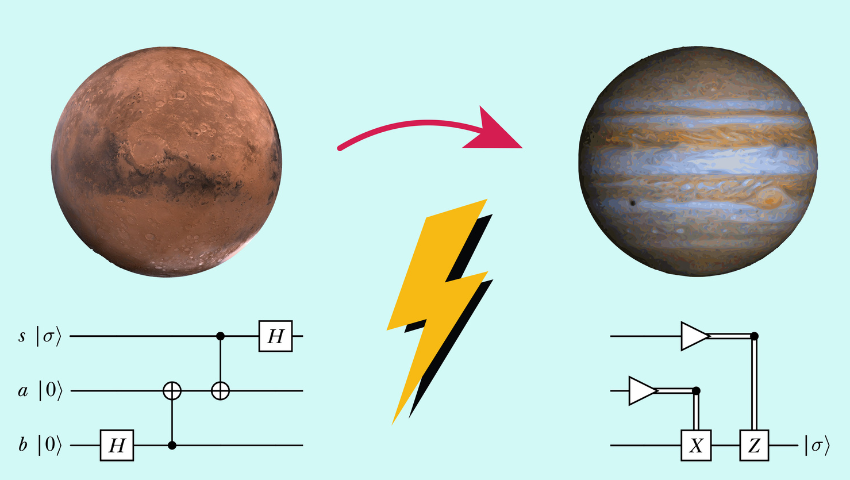
Image credit: © 2026 Andrew Glassner
Quantum computing can feel both intriguing and opaque — a field defined as much by unfamiliar concepts as by its potential to reshape how we think about computation itself. At SIGGRAPH 2026, longtime contributor Andrew Glassner returns with a series of sessions designed to make this emerging space more accessible to the computer graphics community. Known for his ability to unpack complex ideas with clarity and curiosity, Glassner invites attendees to explore the foundational principles of quantum computing, from qubits and superposition to entirely new approaches, algorithms, and problem-solving.
As interest in quantum computing continues to grow within SIGGRAPH, its relevance to graphics, simulation, and interactive techniques is becoming harder to ignore. While much of its impact remains to be discovered, the field offers a compelling opportunity to rethink long-standing assumptions — and to imagine new creative and technical possibilities. We spoke with Glassner about what drew him to quantum computing, how he approaches teaching it, and where he hopes the conversation will go next.
SIGGRAPH: What first sparked your interest in quantum computing — and what makes it especially relevant for the SIGGRAPH community right now?
Andrew Glassner (AG): I read an article on quantum computing and nothing made sense. Bits that produce unpredictable values when read? Billions of parallel evaluations of different sets of inputs, but only one output, and maybe not even a good one? Computer programs without for loops or copying variables? The intellectual and practical allure was irresistible. The underlying technology is accelerating and large, reliable quantum computers are drawing ever closer. They offer us the chance to completely re-think our algorithms and even our fundamental ideas. Quantum computing will enable us to think about computer graphics and interactive techniques in unexpected ways.
SIGGRAPH: For attendees who are completely new to the topic, how do you help make ideas like qubits or superposition feel intuitive rather than intimidating?
AG: There are only a handful of core ideas behind quantum computing. Some people think they’re strange or weird, but they’re really just different from what we’re used to. I introduce these essential principles using a deck of playing cards, where each card is a little box with a computer inside. We can write any software we like for the cards, so I discuss four particular programs we might write, emulating the key ideas of quantum computing. These are perfectly fine little bits of software — you could build these cards, hardware and programming and all, in an evening. This gives us a friendly way to get comfortable with what makes quantum computers special.
SIGGRAPH: Looking at the field of computer graphics, where do you see quantum computing having the most potential to change how we approach problems like rendering, simulation, or optimization?
AG: We just don’t know yet, and that’s a big part of the fun! In general, quantum computers are not speedup machines that take today’s algorithms and make them faster. To make use of their power, we usually need to radically re-imagine a problem to make use of the special capabilities of quantum computing. It’s hard to predict what we’ll discover once we have machines on which to develop and play and experiment.
SIGGRAPH: Interest in quantum computing has been growing at SIGGRAPH over the past few years — what do you think is driving that momentum now?
AG: The SIGGRAPH community thrives on novel ideas. Quantum computing is full of these. People are starting to revisit our familiar algorithms and techniques, looking for alternative approaches that benefit from this hardware. Quantum computers are now available for use, and I think people are getting excited by the opportunity to see what we can do with them and how they can help our field.
SIGGRAPH: What makes SIGGRAPH a meaningful environment for exploring a topic like this, compared to other technical or academic spaces?
AG: It’s the people. SIGGRAPH unites scientists and developers with artists working in every medium and style. When the people building tools and the people using them sit side by side, communicating freely in mutual respect and creativity, special kinds of magic can happen.
SIGGRAPH: As this space continues to evolve, what kinds of conversations or breakthroughs would you most like to see emerge next?
AG: I’d love to see collaborations of technologists and artists exploring what’s possible now by actually building stuff. Real projects will help us see how and where this technology can help us and inspire more people to join in. Right now, quantum computers are so new that much of their value is often discussed in theoretical terms, so I’d like to see us roll up our sleeves and put it to work.
Interested in viewing Glassner’s courses? Be sure to register for SIGGRAPH 2026. Check out all Courses you can expect at SIGGRAPH 2026 on the full schedule now.

Andrew Glassner is a consultant in computer graphics, AI, and quantum computing. He served as Papers Chair of SIGGRAPH ’94, Founding Editor of the Journal of Computer Graphics Tools, and Editor-in-Chief of ACM Transactions on Graphics. Books he wrote or edited include “Principles of Digital Image Synthesis”, the “Graphics Gems” series, “Deep Learning: A Visual Approach”, and most recently “Quantum Computing: From Concepts to Code”. He has written and/or directed short films, novels, animations, and online games. Andrew has given many SIGGRAPH presentations that share fascinating ideas in clear and approachable ways.