Image credit: © 2026 Sihwa Park
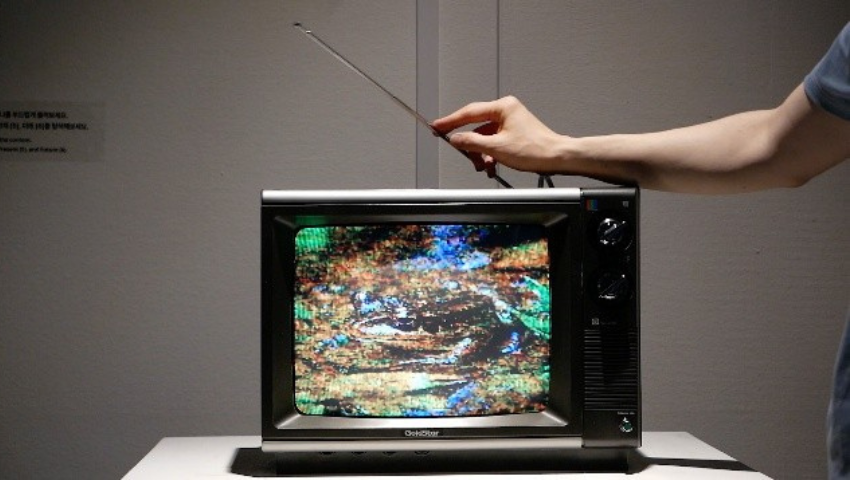
The SIGGRAPH 2026 Art Gallery installation “Diffusion TV” explores the hidden processes behind AI-generated imagery through an interactive, nostalgic interface. Created by Sihwa Park, the work transforms a modified CRT television into a tactile entry point for understanding diffusion models, inviting viewers to tune, adjust, and uncover how chaotic signals evolve into recognizable forms. We spoke with Park about the technical challenges, creative decisions, and broader questions driving the project.
SIGGRAPH: What were the key technical challenges in connecting real-time user input, like turning knobs or adjusting the antenna, to the behavior of the AI-generated outputs?
Sihwa Park (SP): Designing the system that connects physical interaction with AI-generated audiovisual outputs was the most challenging aspect of Diffusion TV. The work consists of a modified CRT TV (GoldStar CMX-4200 13”, 1987), a Raspberry Pi 5 running a custom client program, and a custom sensor system that captures user interaction. The Raspberry Pi outputs generated audiovisual content through a modified HDMI-to-radio frequency (RF) modulator for display on the CRT TV.
One of the biggest challenges was integrating sensing components into the TV while preserving its original appearance and functionality. I wanted the interaction to feel as though the TV itself was doing something magical, rather than appearing as a visibly hacked device. To achieve this, all sensors — including rotary and magnetic encoders, as well as wiring — had to remain hidden inside the TV enclosure. This required designing custom internal connectors and brackets. The antenna mechanism was particularly difficult because I needed to physically bridge a telescopic antenna to a rotary encoder. I went through multiple iterations of designing, 3D printing, testing, and refining custom connector parts before arriving at a solution.
Another challenge was detecting and responding to channel changes between the three dedicated TV channels: Past, Present, and Future. To control the RF modulator programmatically while preserving the authentic behavior of analog TV, I modified the modulator’s circuit board to electronically simulate channel-up and channel-down button presses. This approach allowed the work to retain the static visuals and noise associated with unused TV channels, reinforcing the nostalgic broadcast experience.
A final challenge involved mapping user interaction in real time to intermediate stages of AI generation. This introduced a tradeoff between visual quality, responsiveness, and computational latency. Running diffusion models locally in real time would require high-end GPUs with substantial memory, or, alternatively, smaller models with reduced output quality. Since I wanted the generated imagery and sound to remain detailed and realistic, I used Stable Diffusion XL and Stable Audio Open, running inference through Google Colab. Rather than generating outputs live during interaction, the system pre-generates audiovisual sequences representing different denoising stages, synchronizes them through Google Drive, and updates content asynchronously on the client without interrupting the ongoing interaction experience.
SIGGRAPH: The progression from Past to Future suggests a kind of speculative timeline. How did you approach building continuity — or contrast — across these three channels?
SP: I approached the three channels as different temporal lenses through which audiences encounter the same underlying generative process. The continuity comes from the shared interaction model: Viewers always engage with denoising by adjusting the antenna, regardless of the channel. Manipulating the antenna to search for clearer signals becomes a metaphor for remembering, preserving, or speculating about the existence of species across different temporal states. This creates a consistent embodied experience throughout the work.
At the same time, each channel introduces a distinct narrative and emotional context. The Past channel focuses on extinct species and themes of disappearance and irreversibility. The Present channel centers on critically endangered animals, emphasizing ecological fragility and ongoing crisis. The Future channel shifts toward speculative species imagined through AI, opening questions about environmental futures and the relationship between technological and biological evolution.
I was interested in creating both continuity and contrast. The channels are connected through the same broadcast interface, generative logic, and denoising interaction, but they differ in temporal framing, visual identity, and interpretation. Even the lower-third graphics use different typographic treatments to reinforce each channel’s tone while maintaining the overall language of broadcast television.
SIGGRAPH: Can you share more about your workflow for generating and curating the imagery and sound across the three channels? How did you balance artistic control with the unpredictability of AI systems?
SP: The workflow combined structured research, generative AI, and manual curation. For the Past and Present channels, I first built datasets of extinct and critically endangered species using sources such as the IUCN Red List and World Wildlife Fund. Alongside the species names, I collected contextual information such as extinction dates, population estimates, and habitats, which later informed the lower-third broadcast graphics shown in the installation.
The Future channel followed a different workflow. I used ChatGPT to speculate on plausible future species emerging in specific climate scenarios, such as a warmer high-CO2 world with acidified oceans and disappearing Arctic ice. The model generated fictional species names, environmental triggers, short descriptions, and initial prompts for image and sound generation. I treated these outputs less as final content and more as creative starting points that I could refine and reinterpret.
For the Past and Present channels, the main curatorial challenge was not only selecting the species, but also making the generated audiovisual outputs feel coherent. Some sound outputs were mismatched, incongruent, or physically implausible in relation to the animals or their habitats, especially for species whose actual sounds are difficult to know or represent. I revised prompts, tested multiple seeds, and sometimes emphasized habitat-based ambience rather than literal animal vocalization.
The Future channel involved a different kind of challenge. Because the species were speculative, I needed them to feel plausible as future organisms rather than as fantasy creatures, robots, or existing animals with small modifications. Some early outputs looked too mechanical, too much like concept art, or too similar to familiar animals. I refined the prompts to foreground photorealistic wildlife imagery, biological plausibility, and environmental context, while still allowing the AI system to introduce unexpected forms.
SIGGRAPH: What does it mean to you to share Diffusion TV with the SIGGRAPH community, and how do you hope it resonates with this audience in particular?
SP: Sharing Diffusion TV with the ACM SIGGRAPH community is especially meaningful because SIGGRAPH has long been a space where technical innovation and experimental artistic practice intersect. I hope the work resonates with audiences as an alternative way of understanding complex AI mechanisms through tangible, embodied interaction and artistic interpretation rather than through technical explanation alone.
Many AI artworks tend to emphasize polished final outputs, but Diffusion TV instead foregrounds the generative process itself. By allowing audiences to physically interact with denoising through a familiar CRT TV interface, the work invites viewers to experience AI generation as something gradual, unstable, and participatory rather than instantaneous and invisible.
SIGGRAPH: The SIGGRAPH conference brings together both technical and creative perspectives. Where do you see your work sitting within that intersection, and what kinds of conversations do you hope it sparks?
SP: I see Diffusion TV situated at the intersection of interactive art, interface design, and generative AI research. The project combines contemporary AI systems with older broadcast technologies, using the material and cultural language of CRT television as both an interface and a metaphor for AI denoising processes.
I hope the work sparks reflection on the interconnected relationships between humanity, technology, and the environment. Through its three channels featuring extinct, endangered, and speculative AI-generated animals, the project encourages audiences to consider what is preserved, what disappears, and what kinds of futures are being shaped through technological advancement.
Interested in viewing Diffusion TV, or other featured installations? Be sure to register for SIGGRAPH 2026 and visit the Art Gallery. Check out all Art Gallery installations you can expect at SIGGRAPH 2026 on the full schedule now.
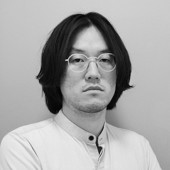
Sihwa Park is a sound interaction designer, media artist, and assistant professor in the Department of Computational Arts at York University, where he is also a research-enhanced faculty member within the Connected Minds program. He explores the intricate relationship between humans and machines, entangled with data and algorithms, through interdisciplinary approaches such as data visualization/sonification, generative art, and ML/AI. Park’s current research focuses on the creative and critical use of ML/AI in interactive, generative audiovisual art. His work has been presented internationally at exhibitions and conferences, including ICMC, NIME, ISEA, IEEE VISAP, SIGGRAPH Asia, CVPR AI Art Gallery, NeurIPS, ACM CHI, and Ars Electronica. He holds a Ph.D. in Media Arts and Technology from the University of California, Santa Barbara.