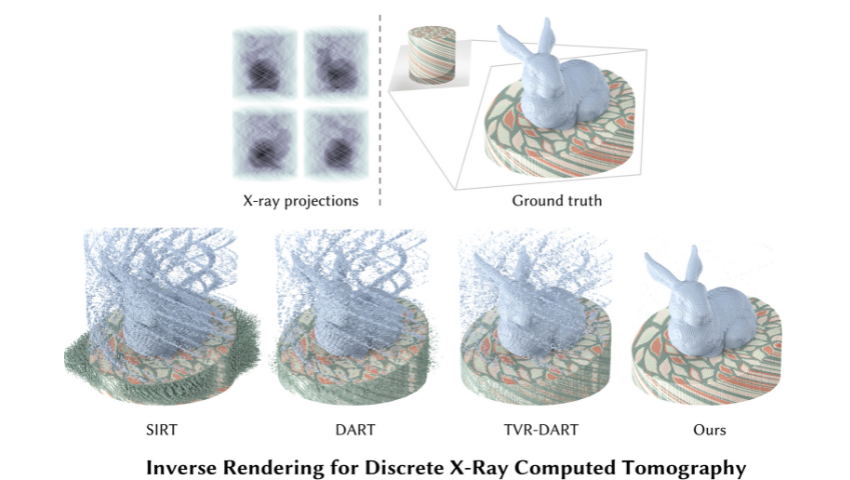
Image credit: Representative result from “Inverse Rendering for Discrete X-Ray Computed Tomography”. Courtesy of the authors.
The SIGGRAPH Technical Papers program is the leading forum for presenting high-quality, scholarly research in computer graphics and interactive techniques. This program is a cornerstone of the conference, highlighting the most respected innovations advancing the field and influencing the future of areas including but not limited to animation, simulation, imaging, geometry, rendering, modeling, generative AI, and machine learning for visual computing. At SIGGRAPH 2026, taking place 19–23 July in Los Angeles, emerging research themes include generative image modeling, Monte Carlo Solvers, 3D vectorization, and more.
SIGGRAPH 2026 Technical Papers saw strong interest with more than 1,120 submissions — a milestone number across SIGGRAPH’s 53 years. Once again, SIGGRAPH 2026 accepted submissions to two integrated paper tracks: Journal (ACM Transactions on Graphics) and Conference. Additionally, the Technical Papers program honors exceptional research with the Best Papers, Honorable Mentions, and Test-of-Time Awards.
SIGGRAPH 2026 Technical Papers Chair Mirela Ben-Chen presents these award-winning papers in collaboration with Best Papers Award Committee Chair Tamy Boubekeur and Test-of-Time Committee Chair Sylvain Paris, who all acknowledge the contributions of the selection committees who chose the Best Papers, Honorable Mentions, and Test-of-Time awardees.
Learn more about the awardees below, and prepare to explore what’s next in computer graphics research at SIGGRAPH 2026.
Best Papers
GimmBO: Interactive Generative Image Model Merging via Bayesian Optimization
GimmBO helps users interactively explore combinations of customized image generation styles to create desired results. It replaces manual slider tuning with a tailored Preferential Bayesian Optimization approach, outperforming alternatives in simulations and user studies. It further extends to combining content and scaling to large model collections by integrating model retrieval. Attend the session.
Chenxi Liu, Selena Ling, Alec Jacobson
Mixwell: Sharp 2D Fluid Brushes for Progressive Physics-Based Mixing
Mixwell introduces sharp 2D fluid brushes and GPU-accelerated analytical methods for progressive, resolution-independent, physics-based mixing. Derived from potential flow around cylindrical tines, Mixwell evaluates drift per sample without grids or intermediate resampling, enabling real-time, arbitrary-resolution fluid mixing, and rendering with negligible numerical dissipation. Attend the session.
Doug James, Ethan James
Walk on Decomposed Subdomains: A Hybrid Monte Carlo-Deterministic Solver for Elliptic PDEs
We introduce a hybrid Monte Carlo-deterministic solver for elliptic PDEs on complex geometries. Our method decomposes the domain into simple subdomains, estimates local solution operators with Monte Carlo, and couples them via a sparse linear system, delivering low-variance solutions orders of magnitude faster than pure Monte Carlo, without volumetric meshing. Attend the session.
Clément Jambon, Mohammad Sina Nabizadeh, Mina Konaković Luković
Robust Planar Maps for 3D Vectorization
Vectorizing 3D scenes into 2D vector images requires planar maps to define solid, non-overlapping regions. Existing planar map methods are slow and susceptible to numerical instability. We introduce a robust and efficient method for constructing planar maps, using a spatial hierarchy as the fundamental representation of the planar map. Attend the session.
Robert Fuchs, Keenan Crane
Inverse Rendering for Discrete X-Ray Computed Tomography
We propose a gradient-based discrete tomography method that models each voxel as a probability distribution over known materials, minimizing an object-space loss for projection consistency. Inspired by inverse rendering, it outperforms classical methods, supports scattering, and excels in sparse and limited-angle scenarios. Attend the session.
Lovro Nuic, Ziyi Zhang, Korbinian Sager, Wenzel Jakob
Honorable Mentions
Uncertainty-Aware Geometry Processing on Gaussian Process Implicit Surfaces
Baptiste Genest, David Coeurjolly
Spatiotemporal FLIP for Fast Free-Surface and Two-Phase Simulation With Very Large Time Steps
Bernhard Braun, Rene Winchenbach, Jan Bender, Nils Thuerey
Gradient Domain Reconstruction for Monte Carlo PDE Solvers
Jiaqi Wu, Xuejun Hu, Shuang Zhao, Kun Xu
Spatio-Temporal Control Variates with ReSTIR for Real-Time Rendering
Zhong Shi, Cunhao Wu, Lifan Wu, Kun Xu
Sample Matching for Joint Extinction Gradient Estimation in Differentiable Volume Rendering
Ruihan Yu, Yu-Chen Wang, Jingwang Ling, Feng Xu, Shuang Zhao
Inspiration Seeds: Learning Non-Literal Visual Combinations for Generative Exploration
Kfir Goldberg, Elad Richardson, Yael Vinker
A Two-Millisecond Passthrough Headset for Perceptual Studies
Eric Penner, Josephine D’Angelo, Clinton Smith, Nathan Matsuda, Neethan Siva, Phillip Guan
Stochastic Geomorphological Transport for Terrain Erosion Simulation
Nicholas McDonald, Guillaume Cordonnier
Implicit Minimal Surfaces for Bijective Correspondences
Etienne Corman, Yousuf Soliman, Robin Magnet, Mark Gillespie
Photons × Force: Differentiable Radiation Pressure Modeling
Charles Constant, Santosh Bhattarai, Elizabeth Bates, Marek Ziebart, Tobias Ritschel
Test-of-Time Awards
ACM SIGGRAPH is proud to announce the 2026 Test-of-Time Award papers that have had a significant and lasting impact on computer graphics and interactive techniques over at least a decade. This is the fourth year of this annual award. For 2026, the papers presented at SIGGRAPH conferences from 2014 to 2016 were considered by the Test-of-Time Award committee, and the committee selected four winning papers.
A Deep Learning Framework for Character Motion Synthesis and Editing (2016)
We present a framework to synthesize character movements based on high level parameters, such that the produced movements respect the manifold of human motion, trained on a large motion capture dataset. The learned motion manifold, which is represented by the hidden units of a convolutional autoencoder, represents motion data in sparse components which can be combined to produce a wide range of complex movements. Read this paper online.
Daniel Holden, Jun Saito, Taku Komura
Convolutional Wasserstein Distances: Efficient Optimal Transportation on Geometric Domains (2015)
This paper introduces a new class of algorithms for optimization problems involving optimal transportation over geometric domains. Our main contribution is to show that optimal transportation can be made tractable over large domains used in graphics, such as images and triangle meshes, improving performance by orders of magnitude compared to previous work. Read this paper online.
Justin Solomon, Fernando de Goes, Gabriel Peyré, Marco Cuturi, Adrian Butscher, Andy Nguyen, Tao Du, Leonidas Guibas
Intrinsic Images in the Wild (2014)
In this paper we introduce Intrinsic Images in the Wild, a large-scale, public dataset for evaluating intrinsic image decompositions of indoor scenes. We create this benchmark through millions of crowdsourced annotations of relative comparisons of material properties at pairs of points in each scene. Read this paper online.
Sean Bell, Kavita Bala, Noah Snavely
A Machine Learning Approach for Filtering Monte Carlo Noise (2015)
In this paper, we observe there is a complex relationship between the noisy scene data and the ideal filter parameters and propose to learn this relationship using a nonlinear regression model. To do this, we use a multilayer perceptron neural network and combine it with a matching filter during both training and testing. Read this paper online.
Nima Khademi Kalantari, Steve Bako, Pradeep Sen
Register for SIGGRAPH 2026, taking place 19–23 July in Los Angeles, to access the leading scholarly research in computer graphics and interactive techniques. View the full schedule to discover all Technical Papers being presented, and be sure to attend Papers Fast Forward on Sunday, 19 July, at 6 pm PDT.