Image credit: Courtesy of Thalia Archibald
When a magnetic tape containing UNIX Version 4 surfaced at the University of Utah, it revealed a version of the operating system long believed to be lost. As the first public release of UNIX written in the C programming language, UNIX V4 represents a pivotal moment in computing history. Ahead of her Frontier Talk “UNIX V4 and the Utah Teapot,” Thalia Archibald gives a glimpse into the discovery and reflects on the significance the 50-year-old tape still holds today.
SIGGRAPH: What was your reaction when you realized this tape contained a version of UNIX that was thought to be lost?
Thalia Archibald (TA): When the discovery of the UNIX V4 tape was announced, I was in my lab doing some work for the advanced operating systems class. We were building our own operating systems in Rust, and I was investigating recent patches to the Rust for Linux project as inspiration. Then my phone showed an email notification “[TUHS] unix v4 tape found” from the Unix Heritage Society and I jumped out of my chair. I was ecstatic!
I had spent the previous summer programming with UNIX as it was in 1975 and immediately recognized the announcement’s significance. In an effort to recreate an early UNIX development environment, I had been running UNIX V5 on my PiDP-11 replica computer and writing C and assembly software using the tools of that time. I knew that UNIX V5 was the earliest complete distribution that had survived — only fragmentary portions of earlier versions still existed, such as a notebook of printed code, incomplete backups, and an unfinished kernel. Plus, UNIX V4 was the first version to be written in C, the language that has defined operating systems since, and the first released to the public, so this tape promised to be quite historically significant.
In my excitement, I wrote a message to the grad school’s #random channel explaining the significance. I expected little interest, given the niche topic, but within a minute, Rob Ricci replied that it was his group, the Flux Research Group, that had found the tape. I hadn’t recognized that it was found here at the University of Utah. Excitedly, I gathered my labmates to see the tape across the hall. We all handled it gingerly, fearing we might damage it and erase the precious 50-year-old data.
SIGGRAPH: What connections were you able to uncover between this UNIX distribution, the University of Utah graphics lab, and the development of the Utah teapot?
TA: The University of Utah is well-known for pioneering research in the 1970s in computer graphics and networking, producing leaders of the graphics industry and its role in the development of the Internet as the fourth node of the ARPANET, but it was not known for being an early adopter of UNIX. Seeking to reconcile this mystery, I dug through archives for any background I could find.
My best source was a list of the earliest UNIX users outside of Bell Labs. Listed at No. 19 was Martin Newell of the University of Utah, complete with a phone number that still directs to the School of Computing’s front desk.
Newell is best known for modeling the famous Utah teapot, a standard model in computer graphics which has appeared in numerous productions. He modeled it from his household teapot in early- to mid-1974, as an example for his dissertation using Bézier patches. Then, his student Jim Blinn found it to be a useful test model and used it to demonstrate textures and reflection in a 1976 paper. The version familiar today was squished by Blinn for aesthetics and its popularity spread from there.
When the UNIX V4 tape was produced in June 1974, Newell was setting up a new graphics lab based on a PDP-11/45 computer, the premier system for that version of UNIX. Blinn produced his later renderings of the teapot with this machine, though Newell’s teapot renderings were produced with the earlier PDP-10 setup. This computer was probably what the copy of UNIX was intended for, but recollections indicate operating systems from the manufacturer were used instead. UNIX was not used for computer graphics research until later versions. This tape’s disuse preserved it.
SIGGRAPH: What does UNIX V4 reveal about the computing environment in which researchers like Newell worked during the early days of computer graphics?
TA: Early computer graphics research was building the foundations we now take for granted. Newell’s dissertation introduced procedure models, models produced algorithmically rather than as a database of coordinates. For example, the Utah teapot was represented with Bézier patches. Today, the term refers to even higher-level descriptions.
Researchers worked much closer to the hardware than today. Newell was a system administrator, placing him in the right environment to be an early adopter of a new operating system. The graphics company Evans & Sutherland, started by two founders of our computer science department, closely collaborated with the university to produce hardware in tandem with research.
SIGGRAPH: How did you go about recovering, authenticating, and exploring the contents of a 50-year-old magnetic tape?
TA: At the university, the equipment to read magnetic tapes is long gone, so we transported the tape to the Computer History Museum’s software preservation lab. There, Al Kossow, the software curator, used a modified tape drive to capture the analog waveform at the point before the drive decodes it as digital data. Then a separate software tool analyzed and recovered the digital data. In this manner, it has enough fidelity to recover from many forms of damage and can support arbitrary tape formats.
The result was 2.4 MiB of digital data decoded from 1.1 GiB of recorded analog signal. The tape was in immaculate condition and the internal checksums validated it.
Due to decades of community work in restoring other UNIX distributions, it was easily resurrected. Within hours after I uploaded the tape image, it was booted for the first time in around 50 years, first in emulation and then on period-appropriate hardware a few days later. Now, orders of magnitude more people have run UNIX V4 than originally licensed it. It’s even been ported to the browser.
The tape contains the source code for the full system, including the kernel and user utilities. I’d consider it to be the smallest useful system, and I find programming on it quite productive. At just under 9k lines of code for the kernel, it can be comprehensible to a single developer and, with UNIX and PDP-11 manuals, you have everything needed to debug.
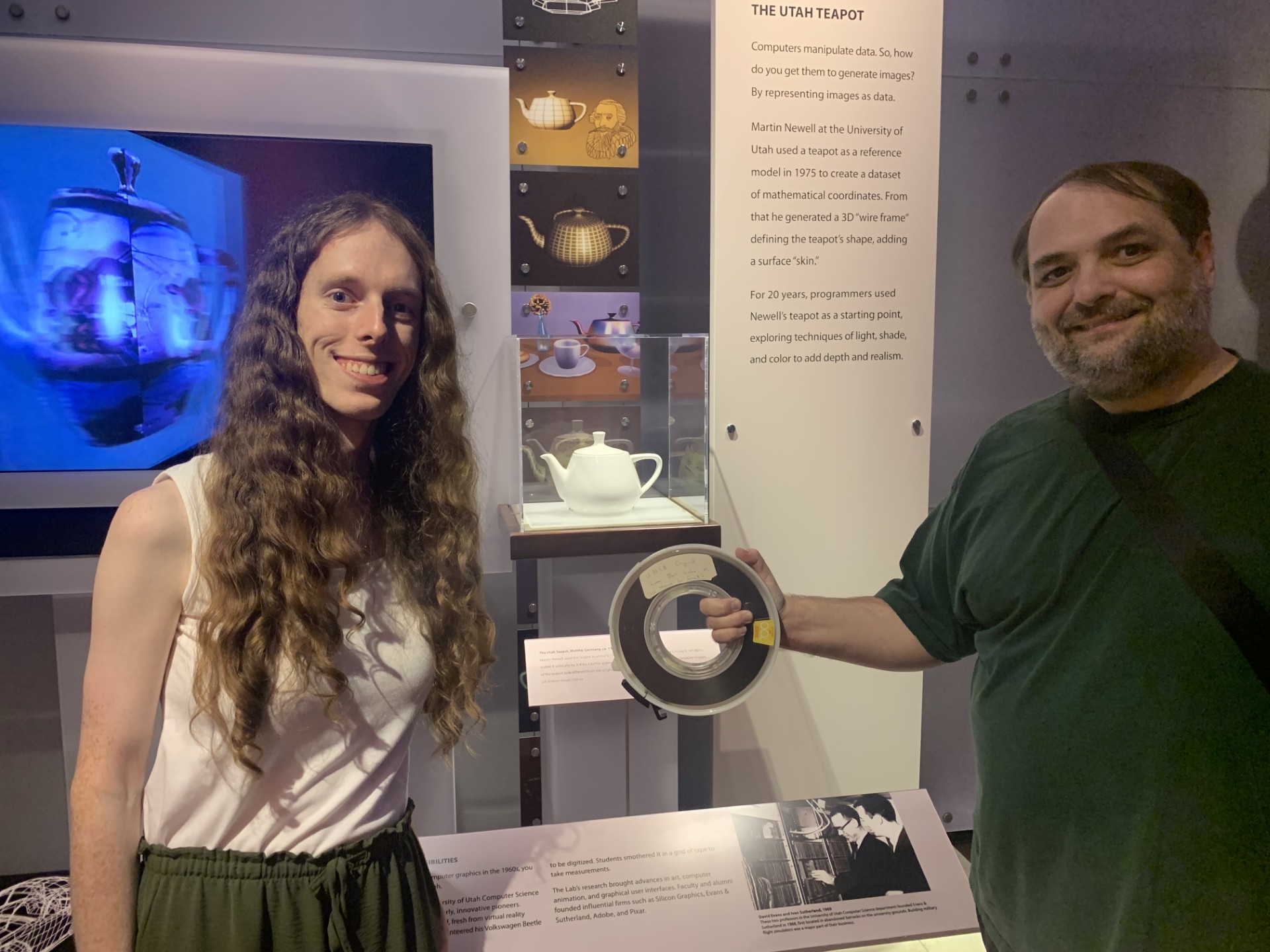
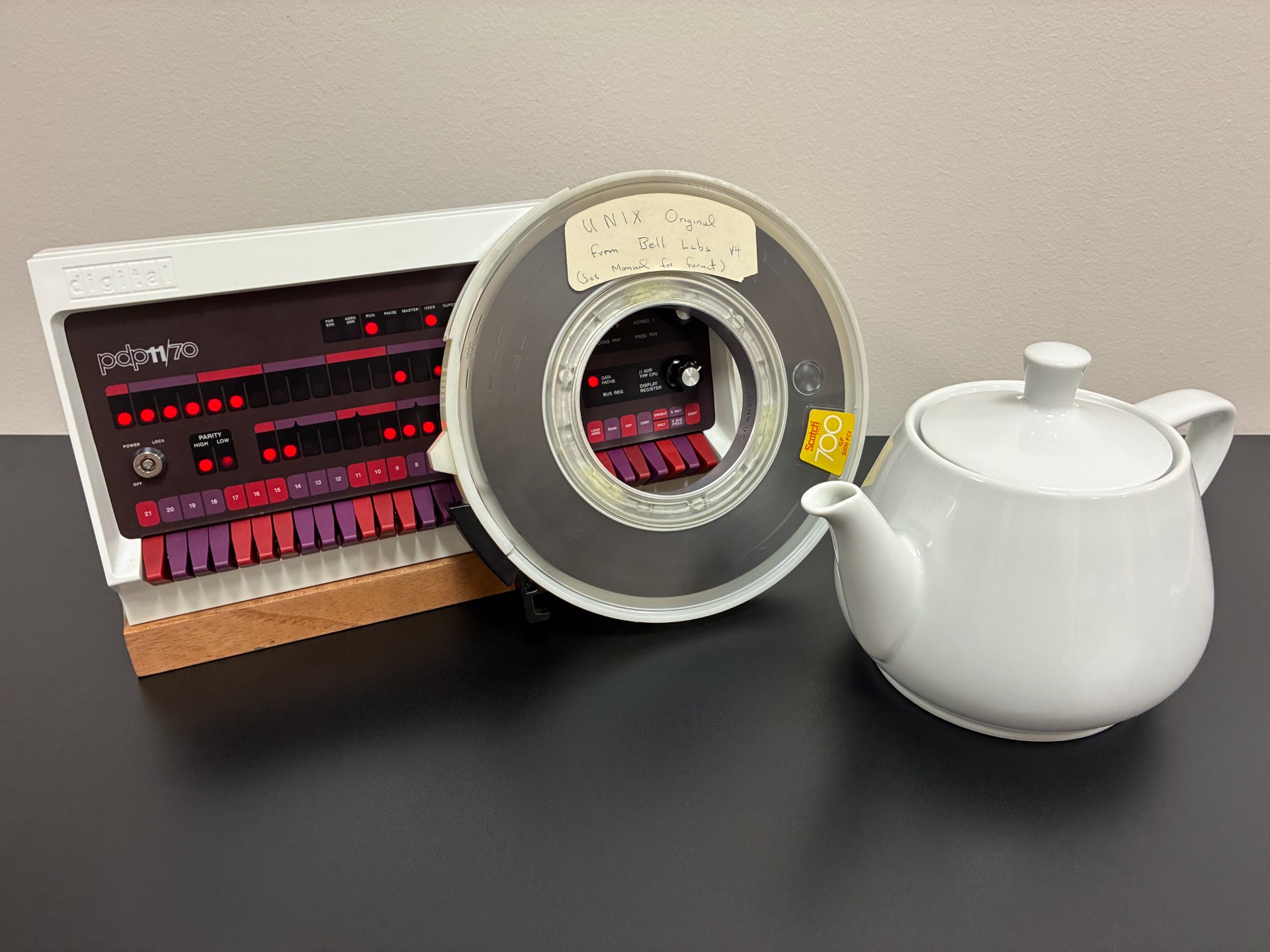
Above: Thalia Archibald and Jon Duerig with the UNIX V4 tape and the original Utah teapot at the Computer History Museum on the day of the recovery. | Photo credit: Courtesy of Thalia Archibald
SIGGRAPH: Why do you think discoveries like this matter to the SIGGRAPH community today, beyond their historical significance?
TA: Because UNIX focused on developer experience, making an excellent system for interactive development and system administration, it received wide adoption. Now, its influence permeates to all modern operating systems. The Utah teapot was conceived as a model to illustrate a new technique, but its geometric properties make it ideally suited as a test model, leading to its popularity. These cases were early examples in their respective fields, and they solved needs that make them still useful today.
SIGGRAPH: What can contemporary graphics researchers and practitioners learn from revisiting the systems and constraints that shaped some of the field’s foundational work?
TA: Much research in the ’70s was driven by doing more with less. UNIX was born from condensing the large Multics system to core principles that would fit on a tiny PDP-7. Computer graphics researchers developed smarter algorithms and more sophisticated hardware to overcome limitations. Although small by our standards, when rendering the teapot, even a framebuffer of 512 x 512 pixels was too large to fit in memory, so it was implemented on disk and paged into memory. As we are squeezed by slowing growth in hardware capabilities, we have the opportunity to reconsider the excess that has dominated computing since and optimize for what we have.
Interested in learning more? Be sure to explore Frontier Talks and Workshops at SIGGRAPH 2026. View the full schedule to discover more stories from the pioneers, breakthroughs, and moments that continue to influence our industry today.
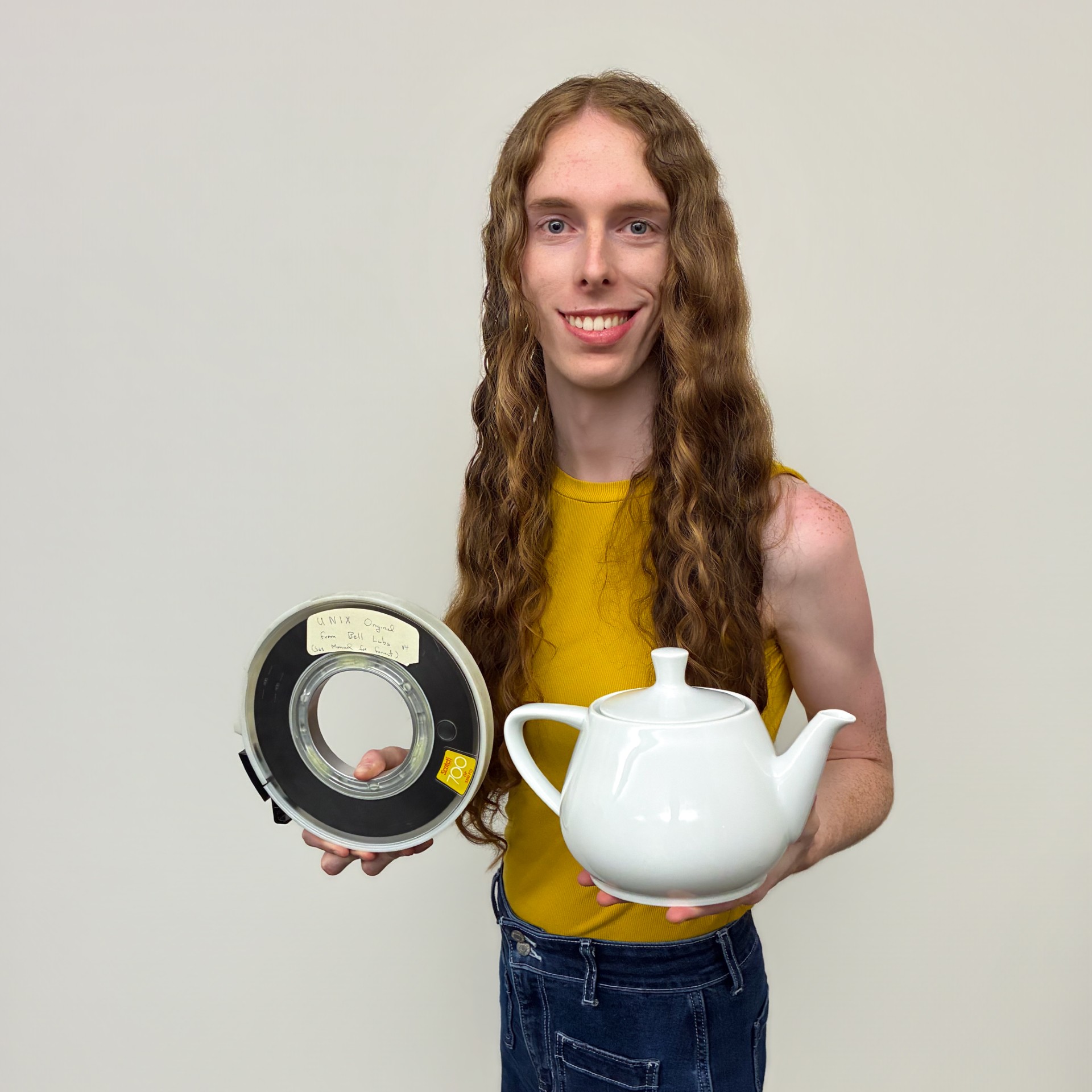
Thalia Archibald is a PhD student in computer science at the University of Utah, researching compiler correctness and verifying LLVM. She is also involved in software history and preservation and is a member of the team behind the Unix Heritage Society.