
Image credit: Matthias von Loebell © 2025 ACM SIGGRAPH
In this episode of SIGGRAPH Spotlight, 2026 Courses Co-Chair Nora Wixom sits down with fellow Program Chairs Adam Bargteil, Callie Holderman, Erik Brunvand, Luke Tannenbaum, and Vernelle Noel to preview the ideas, experiences, and innovations coming to SIGGRAPH 2026 in Los Angeles. From AI and quantum computing to immersive storytelling, critical research, and hands-on learning opportunities, they discuss the trends shaping this year’s conference and share a few highlights attendees won’t want to miss.
Don’t miss a single episode by subscribing to the show on Apple Podcasts (iTunes), Spotify, or SoundCloud. If you like the show, rate and review wherever you listen to help other listeners find us!
About Our Guests

Nora Wixom (she/her) is a digital creative who seeks to create conscientious, enabling technology and further blur the lines between computation and artistry. Prior to her time in tech, she worked as a Character Technical Director at Industrial Light and Magic, where her credited feature films included “Kong: Skull Island”, “Jurassic World”, and “Star Wars: Episode VIII – The Last Jedi”. She then leveraged her VFX industry skills to generate datasets that trained computer vision-based machine learning models for the Vision Pro, Apple’s inaugural augmented reality headset.
Nora is a passionate advocate for STEM education, dedicated to empowering learners of all ages and experience levels. She has volunteered with organizations like Girls Who Code and the California Academy of Sciences and has guest lectured at institutions such as Columbia and MIT. In addition to her commitment to education, she seeks to deepen her relationship to technology through her digital artistic practice, which centers themes of ownership, authenticity, power dynamics, and representation. Most recently, she has studied at the School for Poetic Computation and was invited to participate in the IAAT artist workshop hosted by Zero1.org in 2022.
Currently based in Los Angeles, Nora works as a software engineer at Apple, where she focuses on developing artist tools and applications for the Vision Pro.
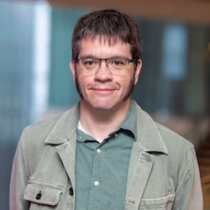
Adam Bargteil is an associate professor in the Department of Computer Science and Electrical Engineering at the University of Maryland, Baltimore County. He completed his Ph.D. in computer science at the University of California at Berkeley and then spent two years as a postdoctoral fellow in the City of Bridges working in the Graphics Lab at Carnegie Mellon University. Before returning home to Maryland, he was an assistant professor in the School of Computing at the University of Utah.
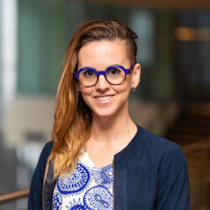
Callie Holderman’s career focuses on content platforms, primarily spanning enterprise SaaS and augmented reality. She cares about making sophisticated technology accessible and simple, so customers (and internal teams) can spend more time being creative and collaborative. Her roles have spanned engineering and product leadership across companies like Snap, Twilio, and Magic Leap.
Callie’s academic career began with UNC Chapel Hill’s Computer Integrated Systems for Microscopy and Manipulation (CISMM) Research Group. Here, she developed visualizations that enabled scientists to both see and interact with the world on a nano scale. She later obtained a BS in a specialized CS program – Digital Arts and Sciences – from the University of Florida.
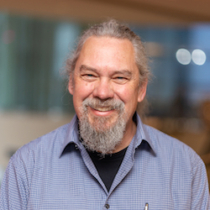
Erik Brunvand is a Professor in the Kahlert School of Computing at the University of Utah in Salt Lake City, Utah, where he has taught and done research for over 30 years. His research and teaching interests include the design of application-specific computers, graphics processors, ray tracing hardware and software, asynchronous systems, and VLSI. Brunvand and his students are currently designing a many-core computer architecture targeted at real-time graphics rendering using ray tracing.
He also has a strong interest in arts/technology collaborations in both education and research. He co-developed and taught a collaborative course with colleagues in the Art department at the University of Utah entitled Embedded Systems and Kinetic Art. This course pairs computer science and art students into teams to design and build collaborative computer-controlled kinetic artworks. He has also developed and taught a course on sound-art as an intro to technology through the lens of using sound as a medium for making art. As an artist, Brunvand is a printmaker, co-founder of Saltgrass Printmakers (nonprofit printmaking studio in Salt Lake City), and he also works in mixed-media computer-controlled kinetic arts.
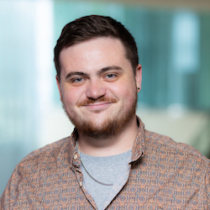
Luke Tannenbaum is a Pipeline Engineer at Epic Games with a background in software, game cinematics, and theater. During his free time, he is an improviser, musician, and tabletop gamer. Starting as a SIGGRAPH Student Volunteer, Luke now has served on SIGGRAPH conference subcommittees for seven years between Real-Time Live! and the Immersive Pavilion. His experience in performance and media have led him to interests in virtual production and technical art, driving his passion for modern immersive content and the technology to support it.
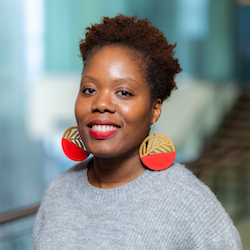
Vernelle A. A. Noel, Ph.D., is an architect, design scholar, artist, TED Speaker, and Director of the Situated Computation + Design Lab at Carnegie Mellon University. She investigates critical questions of embodied practices and computation through craft, making, and heritage practices. Her research has been supported by the Graham Foundation for Advanced Studies in the Fine Arts, the Mozilla Foundation, and ideas2innovation (i2i), among others. Dr. Noel is a recipient of the DigitalFUTURES Young Award for exceptional research and scholarship in the field of critical computational design. She is co-editor of the new book, “Critical Computational Relations in Design, Architecture and the Built Environment” with Dr. Yana Boeva.
Noel’s work is situated at the intersection of computation, ethnographic inquiry, and critical practice. Her scholarship combines methods and concepts from craft, human-computer interaction, media studies, and science and technology studies (STS). A scholar committed to fostering inclusive and minority perspectives on design, making, and technology, Noel conducts workshops and gives talks on design computation extensively across the globe.
Noel has held positions at the Georgia Institute of Technology, the University of Stuttgart, the University of Florida, Penn State University, MIT, and the Singapore University of Technology & Design. She is also the founder, creator, and editor of Architecture Caribbean, an online platform that showcases and promotes design by Caribbean nationals. Noel has a TEDx Talk titled, “The Power of Making: Craft, Computation, and Carnival.” Dr. Noel has been featured on Madame Architect and was a Keynote Speaker at ACADIA 2020.
Vernelle holds a Ph.D. in Architecture (Design Computing) from the Pennsylvania State University, a Masters of Science in Architecture Studies from the Massachusetts Institute of Technology (Design Computation); a Bachelor of Architecture from Howard University, and a Diploma in Civil Engineering from the John S. Donaldson Technical Institute (University of Trinidad & Tobago). Vernelle has practiced as an architect in the US, India, and Trinidad & Tobago.