Image credit: @CreativeSeeds
Grief, distance, and connection sit at the emotional heart of “Beyond Words,” the SIGGRAPH 2026 Computer Animation Festival Best Student Project winner that explores the relationship between a mother and daughter as they navigate loss both together and apart. Through the recurring presence of mysterious black wolves, the film transforms abstract emotions into visual characters, blending expressive storytelling with ambitious technical execution.
Created by a team of artists at Creative Seeds, “Beyond Words” combines complex character animation, effects-driven creatures, custom pipeline development, and stylized visual design to bring its themes to life. We spoke with Antoine Barbannaud about the origins of the project, the evolution of the wolves, and the creative and technical decisions that shaped the film from concept to final frame.
SIGGRAPH: Where did the first idea for “Beyond Words” come from, and how did it evolve during production?
Antoine Barbannaud (AB): Our story follows Alvida and her daughter, Avda, navigating the grief of losing their husband and father. Black wolves emerge as they drift apart, representing the growing divide they must fight against.
The idea of love at a distance in its widest sense was evoked early on, as a theme that touched all of us. Whether it be with a parent, sibling, or a partner, we had all experienced the grief of someone close drifting away, physically or emotionally.
We were all fond of our teammate Lilou Tiprez’s music: She sings, writes, composes, plays, and we had all been to her concerts. She pitched the idea of using music as a means to connect our characters and a central part of the film, and we were definitely excited.
She, along with Damien Poncelet and Gabin Granier, fleshed out the story, pooling from personal experiences and passions, and the full narrative quickly came about.
SIGGRAPH: How did the wolves change from your earliest concept work to the final version that appears in the film?
AB: Our original inspiration for the black wolves was brought by a member of the team, Anthonin Haüy. He noted that black wolves and dogs are often used in pop culture as symbols of depression, loss, or isolation.
We wanted to personify the dark emotions revolving around the grief the mother and her daughter feel, and how it separated them.
Putting this abstract idea on screen raises many questions: Should the wolves be tangible and interact with the real world? Should they leave footsteps? Could the characters touch them and vice versa? All this influenced the look they had and how defined their silhouette would be.
Bridging this with what is possible in 3D was really exciting. We explored different paths: volumetrics, Gaussian Splatting, generating scribbles on top of renders, and various compositing techniques. There are so many exciting ways to convey the same idea which was extremely stimulating to brainstorm.
Eventually, we decided on an approach that was more grounded in 3D. Our wolves had fur that was simulated after animation. Then, multiple smoke and ash simulations were advected from the fur and created a secondary motion that disturbed the edges. This resulted in a vaporous look and allowed us to retain control over per frame intention and silhouette.
Right from the start, we wanted their color to be as dark as possible, almost like a cutout through the screen. This required lots of collaboration between previsualization (previs) and lighting: We always framed shots so there would be a source of light to use as a rim and played with atmosphere to redefine their shape when we were in shadow.
Animating the wolf was all about focusing on silhouette and body mechanics. To help frame the wolf during animation, a hair reference was created to represent the volume fur and smoke would take.
Creating a character that represents the essence of your story is intimidating! It was the first task we started and the last we finished.
SIGGRAPH: Were there any production tools, workflows, or techniques developed specifically to support this project?
AB: Quite early on we knew this was a technically ambitious short film: a fully FX character, CFX on all six characters, 130 shots, and 11 artists working simultaneously. We decided to improve the workflows we knew and implemented tools to iterate faster and with more confidence.
During production, Pierre-Lou Guilloré and I co-developed “Hunter,” a unified pipeline supporting both 2025 graduate films at Creative Seeds. The goal of this pipeline was to scale our productions, reduce manual labor, and provide tools artists could trust when they needed them. We kept the architecture deliberately flexible, so future graduating generations could adapt it to their artistic or technical needs.
We developed a launcher that allowed students to switch between projects and launch all pipeline tools, an asset and shot manager, and implemented support for every DCC used: Maya, Houdini, Guerilla Render, Substance Painter, Rumba Animation, and Nuke. Each application also had a suite of scripts for repetitive tasks and sanity checks. We developed full USD and Alembic workflows through plugins, with transparent publishing and importing.
Over nine months, it supported more than 24 artists, 230 shots, and 400+ assets, with a single developer available day to day.
The second decision was to previsualize lighting and set dressing as early as possible. After initial research into Unreal Engine, we opted for NVIDIA’s USD Composer, since we were already moving to USD.
It let us set dress scenes with light blocking, volumetrics, and depth of field in real time, months before shot work began. Using the asset library, we could drag and drop assets directly into the scene and see how shadows would react.
The third was animation itself: With over 130 shots of full keyframe complex facial animation, lip-sync, bipeds, and quadrupeds, our animation quotas were ambitious with standard workflows. As such, we moved from Maya to Rumba Animation, which helped double our weekly quotas.
Animators could copy and re-use animations between characters and scenes, use much clearer animation layers, drive the wolf’s tail with dynamics, and manipulate the mesh directly through a controller-painting system. They could also visualize their work with real-time feedback and benefit from dynamic updates from our USD set dressing.
SIGGRAPH: Was there a shot or sequence that forced the team to rethink its artistic or technical approach?
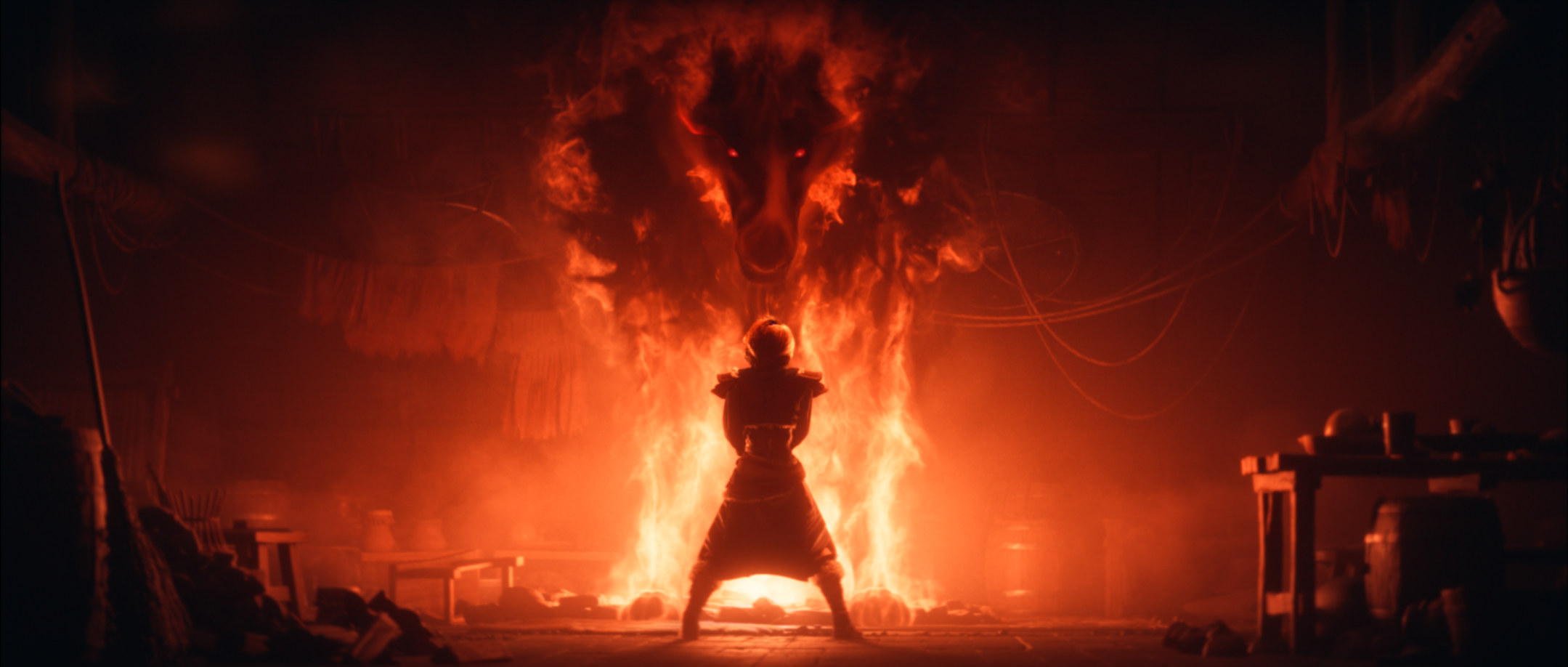
AB: Our red sequence toward the end of the film was definitely a head-scratcher! We showed a matte black wolf catching fire and choreographed a fight, all while keeping a monochrome and heavy atmosphere. We needed to be creative enough to carry the intention of the scene while not distracting the audience.
Because we knew it would be the hardest sequence and need the most iterations, we scheduled it first. This also gave us early animation exports to start FX and lookdev tests for the wolves.
We were lucky to have motion capture suits at our school, which we used for previs. We choreographed, acted, and captured the entire film ourselves, so we had real performances to work from. We could shoot from any angle and choose the framing that best carried the tension.
For the climax, when the wolf stands over the firepit, we blended its existing smoke simulations with the fire, engulfing it over time. It’s the shot where everything we built for the wolves came together: animation, FX, lighting, compositing.
SIGGRAPH: What insights from the making of “Beyond Words” do you have to share with the SIGGRAPH audience?
AB: Start with what scares you the most! Tackling our hardest sequence first and building tools artists could trust during crunch time are decisions that allowed 11 of us to create 130 shots.
Beyond that, every frame is a decision we took and countless hours of work. Finishing a graduate short film isn’t an easy process, and there is so much excitement to see it shown to the world. As technologies evolve, it’s easy to forget how much thought and work goes into every part of a human-made project. We hope audiences will love the story we told and appreciate how we made it happen!
Interested in discovering more emerging talent and innovative storytelling at SIGGRAPH 2026? Explore student films like “Beyond Words” and other featured projects during the Computer Animation Festival. Register for SIGGRAPH 2026 to experience the soon-to-be buzziest works in animation and film.
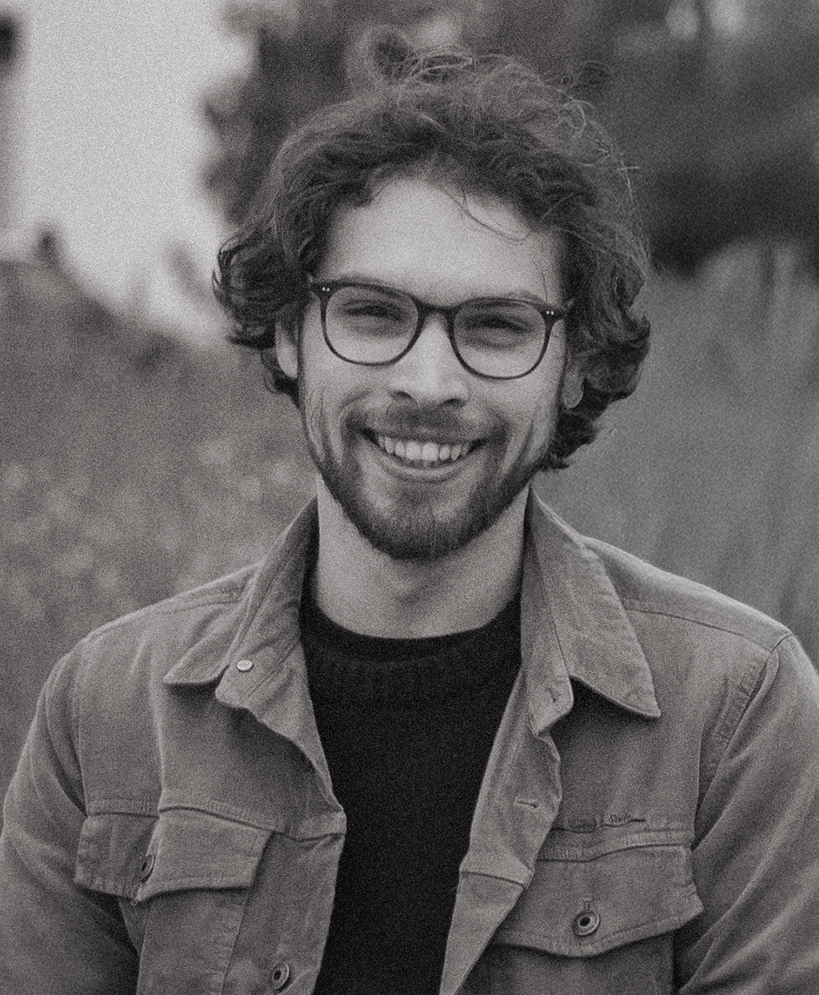
Antoine Barbannaud is an Environment Artist and Generalist TD at Unit Image. At Creative Seeds, he co-developed the Hunter pipeline and worked on lighting and compositing for Beyond Words. With a computer science degree from Université Paris-Saclay and a passion for image making, he works at the intersection of technology and art. Repeatedly told to choose between the two, he has so far successfully avoided the question.