Image credit: Jon Peddie Research (made with Perplexity)
This article was contributed by Jon Peddie of Jon Peddie Research.
This brand-new shiny thing is close to 50 years old.
Sometimes it seems as if artificial intelligence just suddenly arrived, with the introduction of ChatGPT. In reality, its roots reach back more than five decades through computer graphics, games, machine vision, speech, and parallel computing. Each generation solved one piece of the puzzle, often with no recognition of where the work was taking us. Looking back, the path seems remarkably logical. What began as simple game logic evolved into digital humans, machine learning, deep neural networks, and, finally, the GPU-powered AI infrastructure that now underpins modern computing.
We started talking about AI in games in the mid-1980s, before GPUs existed. Then there were a bunch of lookup tables that decided how an enemy in a first-person shooter should react. The tables grew, the reaction-action got more realistic, and everyone just took it for granted that games had smart characters in them.
Next Came the Intelligent Avatars
In the late 1990s, before the introduction of the GPU, Animatek debuted Jennifer, an interactive 3D avatar designed for e-commerce. The developer, Barbra Hayes-Roth, worked with Stanford’s AI research team in 1982, where she began testing and developing models of agents in real-world domains. Jennifer was an interactive “virtual spokesperson” designed to greet and assist consumers at virtual auto shows.
Jennifer was nearly 25 years ahead of the current wave of AI presenters. She lacked large language models and modern speech synthesis, yet she demonstrated the idea that software could gather information, decide what to present, and deliver it through a believable digital personality. That makes her an important milestone in the evolution from computer graphics to AI-driven digital humans.
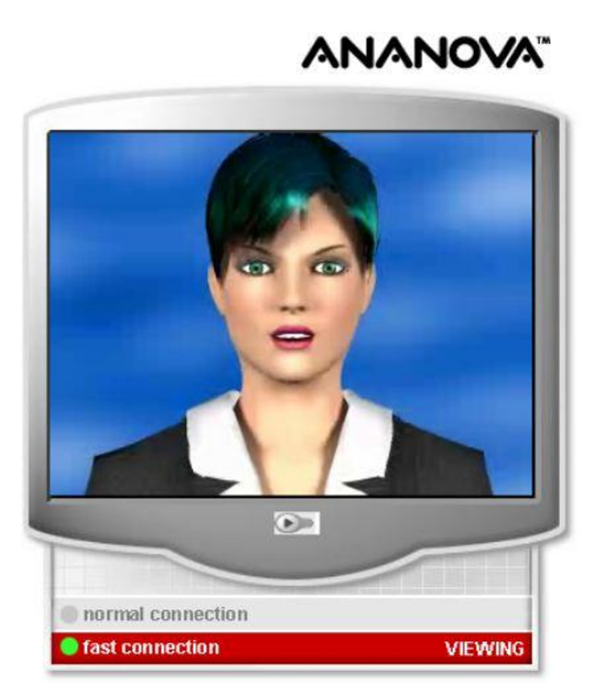
Figure 1. Ananova reads the news to me. Image credit: Originally from Jon Peddie Research article, 2001, from Press Association, London
And in 2001, early AI training was used to create Ananova, an avatar created by looking at thousands of faces and creating a friendly creature of the future. Now the GPUs had a major role to play. Ana, as she became known, would read the news to you, on demand — a kind of pre-streaming approach.
Ananova launched in 2000 (with broad public exposure in 2000–2001) as an automatically generated virtual news presenter. She was created by the U.K. Internet company Ananova Ltd., originally backed by the Press Association. She was powered by SGI workstations and graphics systems.
And Then the Cats Came
Fei-Fei Li’s ImageNet project gave modern AI one of its most important ingredients: scale. She launched the effort in 2007 at Princeton with a view that now looks obvious, but at the time cut against much of the field’s habit of tuning algorithms in small steps. Li argued that computer vision needed a much larger training foundation. Better models mattered, and better data mattered just as much.
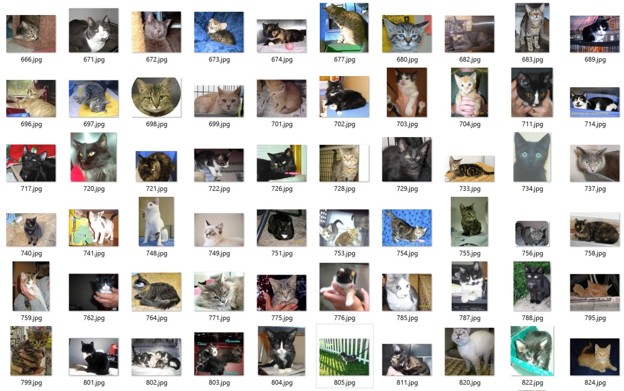
Figure 2. The first AI cat library. Image credit: Fei-Fei Li’s landmark paper, sourced from Research Gate
To build that foundation, she worked with Christiane Fellbaum, one of the creators of WordNet, to organize images into a hierarchy that machines could use. By 2009, the ImageNet team had presented the work at CVPR. The database included millions of labeled images, including thousands of cats across many breeds. Those cats became part of the visual vocabulary that helped machine-learning systems move from lab demos toward practical recognition.
The public often links AI training with “cat pictures” because of Google Brain’s 2012 experiment from Andrew Ng, Jeff Dean, and their team. That project trained a large neural network on 10 million random images from YouTube videos. Cats appeared so often in the data that the system learned to recognize cat faces without anyone explicitly labeling them as cats.
That result captured the industry’s imagination. ImageNet showed that curated data at scale could discipline computer vision. Google Brain showed that huge neural networks could discover useful features from messy web-scale data. Together, they helped shift AI from clever handcrafted methods toward data-hungry deep learning systems that could learn from the world’s visual exhaust.
Machines Can Learn?
By this time, we had begun to talk freely (and, we assumed, knowledgeably) about machine learning, or ML. The term “machine learning” was coined by Arthur Samuel at IBM in 1959, describing his checkers-playing program that improved through self-play. Natural Learning Processing (NLP) as a field traces to even earlier — Alan Turing’s 1950 paper “Computing Machinery and Intelligence” posted the question, “Can machines think?” and proposed the Turing Test. The 1954 Georgetown-IBM experiment translated 60 Russian sentences into English — the first serious NLP demonstration.
Joseph Weizenbaum’s ELIZA (1966) at MIT was the first moment NLP touched a broader audience — a conversational program that mimicked a psychotherapist well enough to fool some users.
Can you hear me now?
Commercial NLP began in enterprise software. Dragon Systems launched NaturallySpeaking in 1997 — the first mass-market continuous dictation product. IBM’s ViaVoice competed directly that same year. Nuance Communications, spun out of SRI International in 1992, eventually acquired Dragon and became the dominant commercial speech platform. Academic foundations came from CMU (hidden Markov model speech recognition), MIT, Stanford, and Bell Labs. Three events pushed NLP into public awareness: IBM Deep Blue beating Kasparov (1997), Google Translate (2006), and Apple Siri (2011) — the first conversational NLP product in mass-market hands.
In 2012, AlexNet dramatically improved ImageNet classification accuracy, marking a milestone in deep learning. That moment — Geoffrey Hinton’s team at the University of Toronto winning the ImageNet competition by a margin that shocked the field — is when the ML research community understood that neural networks had decisively won. The popular press followed about two years later.
And It All Ran on GPUs.
Graphics processing units did not begin as AI accelerators. They evolved into that role through a series of architectural advances that transformed them from fixed-function graphics chips into programmable parallel processors. The introduction of programmable shaders around 2001 gave researchers their first opportunity to use GPUs for non-graphics workloads. Early pioneers demonstrated general-purpose GPU (GPGPU) computing for scientific simulations, image processing, and signal analysis, proving that GPUs could execute thousands of operations simultaneously.
The real breakthrough came in 2006, when NVIDIA introduced CUDA, allowing developers to program GPUs directly in C rather than masking computations as graphics operations. CUDA dramatically lowered the barrier to GPU computing and attracted researchers working on machine learning, linear algebra, and neural networks.
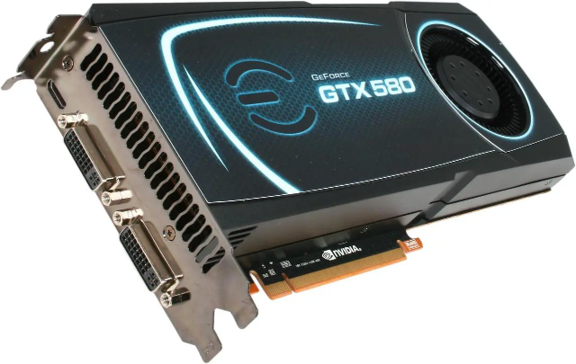
Figure 3. NVIDIA GTX580 started as a game board and became an AI processing pioneer (Source; EVGA)
The next milestone came in 2012 when Alex Krizhevsky, Ilya Sutskever, and Geoffrey Hinton trained AlexNet on two NVIDIA GTX 580 GPUs. Their convolutional neural network cut ImageNet classification errors by an unprecedented margin and demonstrated that GPUs could train deep neural networks far faster than conventional CPUs. At nearly the same time, Andrew Ng, Jeff Dean, Fei-Fei Li, and the Google Brain team showed that large neural networks could learn complex visual concepts, including cats, from millions of unlabeled YouTube images.
| Year | Milestone | AI Significance |
| 1999–2003 | Programmable shaders | GPUs become programmable |
| 2004–2006 | GPGPU | First non-graphics computing |
| 2006 | CUDA introduced | GPUs become practical compute engines |
| 2007–2009 | Early ML | Matrix operations move to GPUs |
| 2009 | ImageNet | Large datasets drive GPU adoption |
| 2010–2011 | Deep CNN research | Neural networks train on GPUs |
| 2012 | AlexNet | GPUs become the standard for AI training |
| 2013–2015 | Deep NLP | RNNs, LSTMs, speech move to GPUs |
| 2017 | Transformers | GPU clusters become essential |
| 2018–present | Tensor Core era | AI becomes the dominant GPU workload |
Table 1. Timeline summary.
Specifically:
- 2006 — CUDA made GPUs practical for general-purpose and AI computing.
- 2012 — AlexNet proved that GPU-accelerated deep learning dramatically outperformed previous approaches.
- 2017 — Transformers shifted GPUs from machine-learning accelerators to the foundational infrastructure for modern AI, NLP, and large language models. Together, these milestones explain how graphics processors evolved into the engines of today’s AI revolution.
Figure 4. GPU-compute, leading to AI processing GPUs have taken off (JPR)
These breakthroughs transformed GPUs from graphics processors into the computational foundation of modern AI. Today, every major AI framework, large language model, and generative AI system depends on GPU acceleration, making the GPU one of the defining technologies behind the AI revolution.
Summary
The evolution of AI followed a steady progression rather than a sudden breakthrough. Early game developers introduced rule-based intelligence through lookup tables that controlled non-player characters. Interactive digital humans such as Jennifer and Ananova demonstrated that software could converse and present information through believable virtual personalities. ImageNet and Google Brain showed that large datasets and neural networks could learn visual concepts instead of relying on handcrafted rules. GPUs, originally designed for graphics but massively multitalented by virtue of their parallelism, became the computational engine that made deep learning practical. Together, these advances transformed AI from a collection of specialized techniques into the foundation of today’s intelligent systems, large language models, and generative AI applications.