Image credit: photo by Matthias von Loebell © 2025 ACM SIGGRAPH
Are you ready for the production insights and takeaways you are going to experience at SIGGRAPH 2026? As we approach the conference, we caught up with the presenters behind two of this year’s Production Sessions: “Chasing De’Snake! – Developing the Worlds and Characters of Disney’s ‘Zootopia 2’” and “Trial by Fire: The VFX of The Lost Bus”. Get a behind-the-scenes preview of one innovation that had the biggest impact on the final result of their work and what will resonate most with the SIGGRAPH 2026 audience.
SIGGRAPH: Every production comes with its own unique challenges and breakthroughs. What was one moment, decision, or innovation from your project that had the biggest impact on the final result?
“Chasing De’Snake! – Developing the Worlds and Characters of Disney’s ‘Zootopia 2’”: Though “Zootopia 2” kicks off right after the events of the original film, 10 years have passed since that production period. Our technical departments developed new tools to accomplish the film’s ambitious scope: Gary De’Snake is the first snake Zootopia has seen in 100 years, the bustling Marsh Market is Zootopia’s first semi-aquatic environment, and the Crowds teams really outdid themselves multiplying a few thousand animals to tens of thousands.
“Trial by Fire: The VFX of The Lost Bus”: For us, it was building a full digital twin of Paradise, California, in Unreal Engine, right from the earliest stages of look development. We used USGS LiDAR elevation data and aerial imagery to reconstruct a terrain of approximately 32 x 40 kilometers. It was not unlike building a big sandbox — once that was done, we could jump in and play.
Having this “sandbox” springboarded new avenues of collaboration and creativity that would not have been possible without it. With this digital twin, our beloFX team could scout angles, chart the fire’s movement, and test lighting, smoke, and wind long before anyone called action on set. This became the foundation underneath nearly every major sequence we touched, and ultimately had a huge impact not just on our work, but on the production as a whole.
A good story that illustrates the impact is what happened when real aerial plates with CAL FIRE became impossible to shoot later in the production (ironically, because of an actual wildfire). Suddenly, those sequences needed to pivot to become entirely CG. Because we already had a geographically accurate, fully art-directable Paradise at the ready, we didn’t lose any of the authenticity we’d been fighting for — we just lit it on fire.
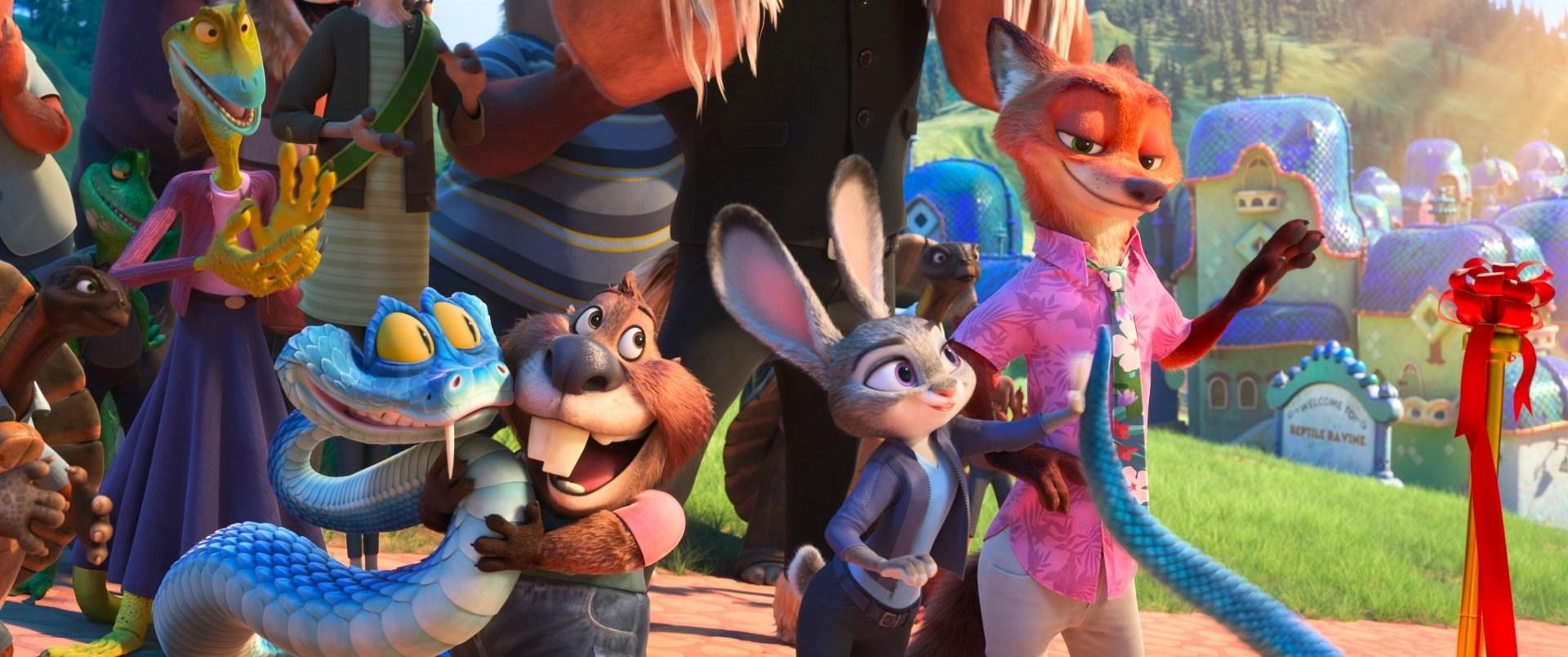
Image credit: © 2026 Disney
SIGGRAPH: Looking at your work in this session, what’s one insight or lesson — creative, technical, or collaborative — that you think will resonate most with the SIGGRAPH community?
“Chasing De’Snake! – Developing the Worlds and Characters of Disney’s ‘Zootopia 2’”: During production, we not only converted to USD, we also shifted our animation from Maya to Presto. The viewer sees one huge, mixed ecosystem in “Zootopia 2”, but those animals were actually animated on two systems using a split strategy. That’s dozens of species of different sizes and locomotion, integrating seamlessly into a really big menagerie. Nearly every scene was “mixed.” Not without a lot of planning and communication, though!
“Trial by Fire: The VFX of The Lost Bus”: The lesson that travels furthest here is the value that comes from bringing VFX “into the room” earlier in the production process (in this case, before there’s even a finished script greenlit!) rather than being handed a cut sequence to “fix” later.
Our beloFX team came on board this production while the film’s future was still unfolding. That timing changed the nature of the relationship: Instead of executing a solidified plan, our team was empowered to help shape it. By building a shared digital world first, we could actively solve for blocking, lighting, and even the emotional pacing of the film from the earliest stages.
For the SIGGRAPH community, the takeaway is about what real-time engines make possible structurally: They collapse the distance between “what if we tried this” and actually seeing it, which means a VFX team can show up with ideas (rather than just deliverables). That shifted beloFX from vendor to creative partner, and we couldn’t be prouder of the outcome.
Don’t miss these inspiring Production Sessions at SIGGRAPH 2026. The program kicks off on Sunday, 19 July, at the Los Angeles Convention Center. Register now — Full Conference and Full Conference Supporter registrants gain access to all Production Sessions programming.