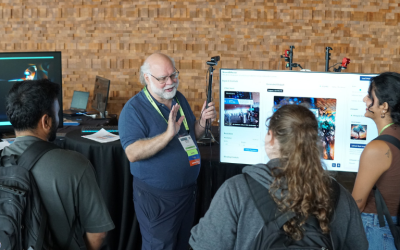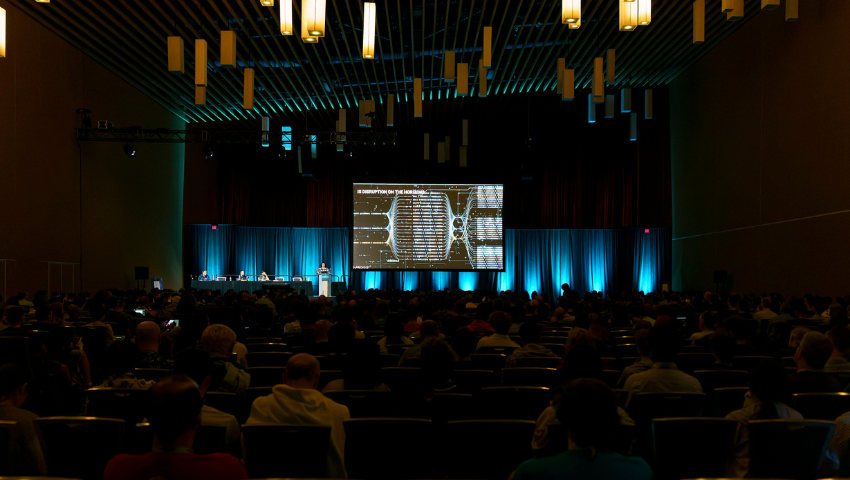
Image Credit: photo by Yuki Wong © 2025 ACM SIGGRAPH
The Courses program has long been the cornerstone of the SIGGRAPH community, serving as a vital hub where presenters from every corner of computer graphics — and far beyond — converge to share specialized knowledge and cross-disciplinary skills. As we look toward SIGGRAPH 2026, we sat down with Courses Co-Chairs Callie Holderman and Nora Wixom to discuss their vision for the program, the introduction of new formats, and how they aim to bridge the gap between entertainment technology and industrial applications.
SIGGRAPH: Courses is a cornerstone program within the SIGGRAPH community as it allows presenters from all areas of computer graphics and beyond to share knowledge and skills from a variety of different disciplines. As co-chairs of the program, what are your goals for this year’s program?
Callie Holderman (CH) and Nora Wixom (NW): Our primary mission is to ensure that Courses provide cohesive programming with the rest of the conference while giving attendees the confidence and awareness of emerging, job-relevant skills in computer graphics. We want to foster a sense of curiosity, ensuring that every working professional and student who attends feels the experience was well worth their time.
Ideally, Courses should leave attendees with a concrete takeaway — whether physical or digital — and provide them with the tools to continue that exploration in their own time. We want people to return home not just with inspiration, but with a specific new bit of knowledge or a tangible skill they can immediately apply.
SIGGRAPH: The Courses program offers three tracks: Hands-On Courses (formerly Labs), Short-Form Courses, and Long-Form Courses. Can you speak to what you and your jury are looking for within these tracks?
CH and NW: For those seeking inspiration, we’ve listed Example Topics of Interest on our website, though we highly welcome topics outside these examples as well. The key is choosing the track that best supports your proposal.
Short- and Long-Form Courses remain similar to previous years, focusing on a lecture format where instructors use slides to present to an audience. While these may include supplemental materials like Jupyter notebooks or optional exercises for follow-along learning, they are primarily lecture-based.
New this year is the Hands-On Courses format, which encompasses what was formerly known as Labs. These sessions will take place in an open classroom, equipped with approximately 50–60 desktop computers. These are intended to be guided, workshop-style sessions led by the presenters, designed for deep, active engagement.
SIGGRAPH: Do you have any advice for a contributor who is unsure which track their work should follow?
CH and NW: As a submitter, you should ask yourself a few critical questions: Will attendees learn the material better if they follow along? Does following along require specific hardware or software that attendees cannot reliably access on their own? What audience am I ideally trying to reach with my submission?
In Hands-On classes, presenters might provide Docker images, specific software, or hardware that attendees wouldn’t have at home; therefore, attendance is limited by the available hardware. These classes are accessible to anyone with Experience-level access and up.
Conversely, Long and Short Courses are for Full Conference access only. Because hardware is not provided, attendance is limited only by the size of the lecture hall, and the follow-along components are generally more self-guided.
SIGGRAPH: Are there specific areas or disciplines where you’d especially like to see more contributions this year?
CH and NW: Absolutely! We are specifically seeking contributions that span both the enterprise and entertainment sectors — from robotics, physical simulation, and aerospace to real-time rendering and AI production workflows.
Beyond these core areas, we are excited about creative submissions that build bridges between diverse interest groups. We are particularly eager to see work that translates the sophisticated skills honed within the entertainment community into “hot” industrial fields and other emerging applications.
SIGGRAPH: Whether you are an expert in your field or you are exploring how to apply computer graphics to your work, the Courses program is there to help expand your foundation and advance your career. What does the Courses program mean to you?
CH and NW: Technology progresses at a remarkable rate, and this has been especially true the last few years. The Courses program shows us that year in and year out, there is always something new to learn and something to discover, regardless of where you might be in your career.
For Holderman, this program is personal: “I attended SIGGRAPH 2024 in Denver specifically to learn what skills I needed to get a job in AI. Taking courses like ‘Introduction to Generative Machine Learning’ gave me the confidence to dive into complex topics from NVIDIA and Khronos. Those connections helped me land an industry job in AI within three months of the conference.”
SIGGRAPH: What common pitfalls should potential Course contributors avoid in their submission materials?
CH and NW: Most importantly, show us that you have considered the attendee experience. If you are proposing a three-hour Long-Form Course, ensure you have enough notes and topics to fill that time and provide materials that attendees can follow up on later. If you are doing a Hands-On session, be very clear about what software or files attendees will need and how you plan to provide access.
The most common pitfall is generality. The more specific your application, the higher the likelihood of acceptance. The jury needs to understand exactly what will be taught and how you will teach it to have confidence that the course will succeed.
Additionally, we recommend that you don’t get too hung up on marketing details, biographies, or representative images in Stage 1 — you will have an extra week to modify those if accepted.
Advance your career with the SIGGRAPH 2026 Courses program. Submissions close on Tuesday, 10 February. Implement the advice from Callie and Nora and submit your work today!
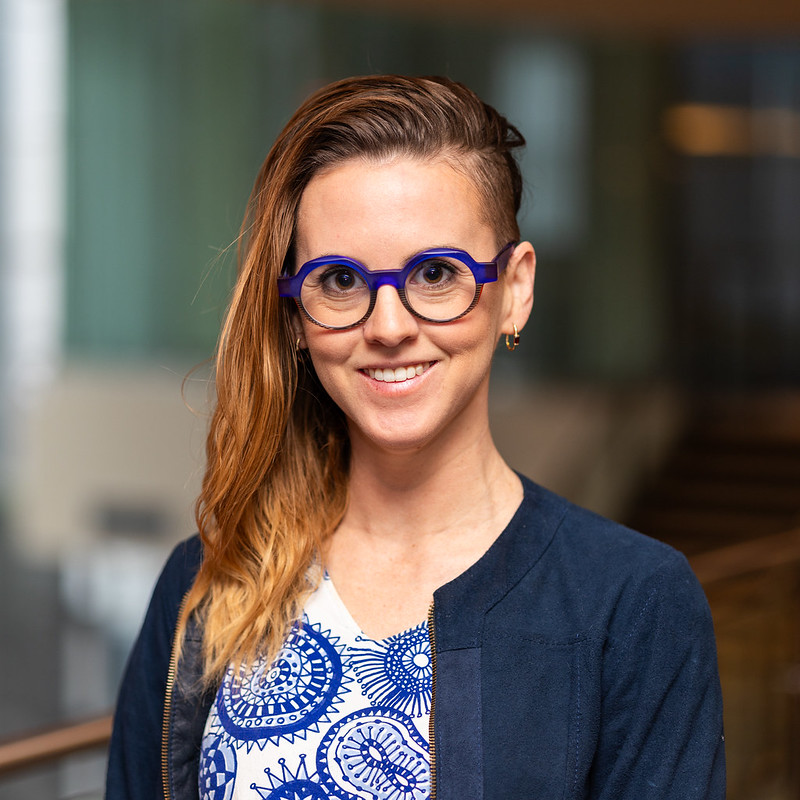
Callie Holderman’s career focuses on content platforms, primarily spanning enterprise SaaS and augmented reality. She cares about making sophisticated technology accessible and simple, so customers (and internal teams) can spend more time being creative and collaborative. Her roles have spanned engineering and product leadership across companies like Snap, Twilio, and Magic Leap.
Callie’s academic career began with UNC Chapel Hill’s Computer Integrated Systems for Microscopy and Manipulation (CISMM) Research Group. Here, she developed visualizations that enabled scientists to both see and interact with the world on a nano scale. She later obtained a BS in a specialized CS program – Digital Arts and Sciences – from the University of Florida.

Nora Wixom (she/her) is a digital creative who seeks to create conscientious, enabling technology and further blur the lines between computation and artistry. Prior to her time in tech, she worked as a Character Technical Director at Industrial Light and Magic, where her credited feature films included “Kong: Skull Island”, “Jurassic World”, and “Star Wars: Episode VIII – The Last Jedi”. She then leveraged her VFX industry skills to generate datasets that trained computer vision-based machine learning models for the Vision Pro, Apple’s inaugural augmented reality headset.
Nora is a passionate advocate for STEM education, dedicated to empowering learners of all ages and experience levels. She has volunteered with organizations like Girls Who Code and the California Academy of Sciences and has guest lectured at institutions such as Columbia and MIT. In addition to her commitment to education, she seeks to deepen her relationship to technology through her digital artistic practice, which centers themes of ownership, authenticity, power dynamics, and representation. Most recently, she has studied at the School for Poetic Computation and was invited to participate in the IAAT artist workshop hosted by Zero1.org in 2022.
Currently based in Los Angeles, Nora works as a software engineer at Apple, where she focuses on developing artist tools and applications for the Vision Pro.