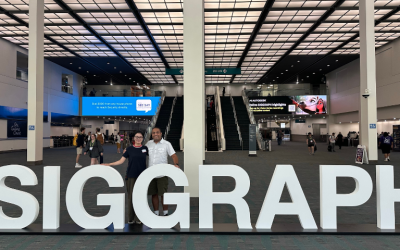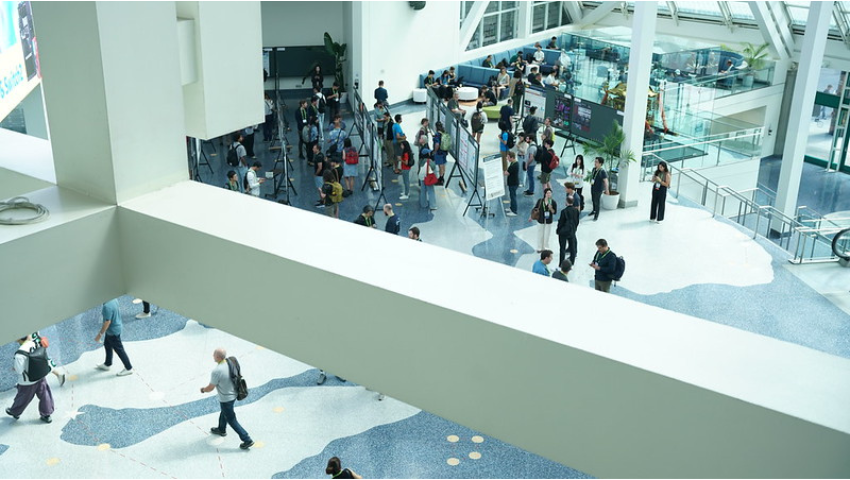
Image credit: photo by Cabe Tejeda © 2026 ACM SIGGRAPH
As we reflect on SIGGRAPH 2026, meet this year’s Student Research Competition winners who are advancing the future of computer graphics and interactive techniques through drone displays, responsive urban design, mixed reality rehabilitation, and immersive model visualization.
SIGGRAPH: Congratulations on your win at the SIGGRAPH 2026 Student Research Competition! Walk us through the spark of inspiration that first set your project in motion.
Hamed Alimohammadzadeh (HA): This work grew out of my PhD research in the Flying Light Specks Lab at USC, where we explore what it could mean to build 3D displays using swarms of miniature flying robots. You can think of it as taking the idea of outdoor drone light shows and bringing it indoors, where the drones can become interactive and part of the experience.
The project started with a simple question: How can a swarm of drones clearly display something like text? Most drone light shows use individual points of light to create images, but we wanted to explore what happens if we move beyond points. That led me to a different design: Drones carrying actuated rods that can create lines of light in the air. I called these LightBenders. In a way, the whole project grew out of that transition from thinking about light as points to thinking about it as lines.
Sasan Bahrami (SB): Thank you very much for recognizing “Sound Sponges” through the Student Research Competition and for giving me the opportunity to present this work at SIGGRAPH.
The initial inspiration for the project goes back to 2022, when I was working at the Design Futures Lab, led by Nicole Koltick. At the time, we were developing an NSF proposal titled “Every Space for Every Body,” which explored speculative approaches to designing urban built environments for people with disabilities. Through this research, we developed two interconnected concepts: Urban Prosthetics and Tangible Urban Interaction, which we later discussed in our 2024 paper presented at the MAD Conference.
This particular direction of the research focused on people with hearing impairments and asked how cities might be reconsidered through a lens of equity. A central idea behind the project is that disability does not reside solely within an individual; the built environment itself can create disabling conditions. Instead of asking people to continuously adapt to cities, we began asking: How might cities adapt to people?
“Sound Sponges” emerged from this question as a speculative urban intervention for transforming problematic acoustic environments. The concept was first published in 2024, and by 2026 we had developed it further by incorporating real-time urban noise data and simulation. Presenting this evolution at SIGGRAPH allowed us to move the project closer to the idea of an interactive, responsive urban digital twin.
Jeremy Varghese (JV): First, thank you for highlighting our work! The project grew out of direct discussions with research directors and doctors at Sunnyview Rehabilitation Hospital to explore how immersive technology could best support their patients. After exploring various ideas, including AR solutions for daily living assistance, we agreed to focus on virtual reality for lower-limb stroke rehabilitation. That core concept has since expanded into a comprehensive mixed reality framework for overground rehabilitation.
Ziyan Xie (ZX): I’ve always had a broad interest in vision and visual phenomena. Working on visual perception at UCLA, I spend a lot of time measuring how what a person perceives depends on viewpoint and viewing conditions, using mixed reality methods. That habit followed me when I started to learn about vision models. A vision transformer reads an image as a grid of patches, and the graphics methods built on those features almost all lift them into 3D by averaging each point’s features over many training views. Every inspection tool I could find was essentially a flat map on a monitor, while what it describes is a spatial phenomenon. That was the click: methods I already knew, pointed at something I wanted to understand more intuitively. So I built an interactive system where one can stand inside the scene, point at anything, and see the model’s grouping and attention for that view painted onto the surfaces it saw. What comes back is more interesting than a fixed property of the surface, as one can watch the same 3D point take on a different embedding from a different camera pose.
SIGGRAPH: Every research journey has hurdles. What was the biggest turning point or unexpected discovery you encountered along the way?
HA: Displaying line strokes using drones required a new kind of drone and new lighting primitives designed specifically for the application. I had to design and build the drones from scratch. The harder problem was getting them to stably fly while carrying an actuated rod of LEDs. That payload isn’t something standard flight controllers are tuned for, so figuring out how to keep the drones stable in the air while actuating the rod was one of the project’s challenges.
SB: One of the biggest challenges has been communicating the language of design justice to broader audiences and demonstrating why concepts such as Urban Prosthetics and Tangible Urban Interaction are worth investigating and investing in. These ideas challenge some conventional assumptions about accessibility: Rather than designing only around an individual’s perceived limitations, we examine the pain points and limitations of the built environment itself.
That challenge became an important turning point. It encouraged us to define these concepts more rigorously and position them in relation to existing approaches such as universal design, while asking where current frameworks might still leave opportunities for more adaptive and responsive urban environments.
Technically, another major hurdle was obtaining meaningful urban noise data that could support a more dynamic simulation. Earlier versions of “Sound Sponges” relied primarily on static or passive datasets. Finding the HowLoud API gave us an opportunity to work with more dynamic noise information and develop the simulation toward a more realistic digital-twin framework. That transition — from a primarily speculative intervention to something that could also be computationally simulated and evaluated — was particularly exciting for us.
JV: We hit plenty of roadblocks, from wading through six months of IRB documentation to realizing full-body tracking wasn’t actually picking up leg movements in VR, which forced us to pivot to mixed reality. But the wildest technical mystery happened right in the middle of clinical trials at the hospital. Whenever a patient walked anywhere near the open gym bathroom, the headset’s spatial tracking would completely lose its orientation. After some head-scratching investigation, I realized that when the bathroom door was open and the light was on, the metallic kick-panel on the bottom half of the door reflected light straight into the headset sensors, throwing off the tracking. We instituted a strict “keep the bathroom door shut” rule during sessions, and the rest of the study ran without a hitch!
ZX: The most important turning point was a failure I could see. My first version projected the model’s read-out in screen space, and it collapsed into a flat decal on whatever wall the aim ray hit. Each patch landed where its ray landed, never on the object it belonged to. The second version drew cluster blobs, which read as a summary of a point rather than a picture of the scene. The fix came from asking what the renderer already solves. Occlusion and curvature are the rasterizer’s job. The final version reprojects through the capture camera in a render pass that shares the main depth buffer, and the overlay hugs geometry for free.
SIGGRAPH: Beyond your winning project, what corners of computer graphics or interactive techniques are you most excited to dive deeper into next?
HA: I’m drawn to the idea of physical augmented reality, where spatial content is integrated into the real world without requiring a headset or glasses. Drone-based displays are one path toward that. What excites me is the possibility of building a collaborative or shared physical augmented reality. Instead of experiencing digital content through a lens or headset as an isolated experience, people could see and interact with the same physical content together.
SB: The next stage that excites me most is moving “Sound Sponges” between the digital and physical worlds. We want to take what we have explored through computational simulation and begin fabricating physical prototypes, eventually developing full-scale Sound Sponge pavilions in areas experiencing significant noise pollution.
From an interactive-technology perspective, this creates an exciting opportunity to connect real-time sensing, simulation, physical fabrication, and human interaction. Rather than only predicting how an intervention might affect an acoustic environment, we could observe how people actually encounter, occupy, and interact with it.
Ultimately, I would like to create a feedback loop between the physical intervention and its digital twin, where environmental and interaction data gathered from real-world deployments can continuously inform the computational model. For me, that transition from simulation to fabrication to interaction and back to simulation is one of the most exciting directions for the project.
JV: I was really impressed by Reallusion’s demo of their live virtual avatar modelling and rigging system. They demonstrated a video feed being directly animated onto a 3D model of the person speaking, and that sparked a lot of ideas for potential use cases in multiple research projects that I am involved in.
ZX: Interpretability and visualization, mostly. There are now a lot of good methods for pulling out what a model represents and much less understanding of how to show it to a person so they draw the right conclusion. That’s the part I want to work on: What to put on screen, what to leave out, how to encode uncertainty so it reads as uncertainty, and how to lay a model’s behavior next to the thing it’s describing so someone can check it. I want to know the model well enough to know what’s worth showing, and I also need to know people well enough to know what they’ll take from it.
SIGGRAPH: Presenting in Los Angeles this year came with a vibrant community and opportunity to share your research on a global stage. What moment from the conference stands out as the most memorable for you?
HA: As a first-time attendee, there was so much to absorb and enjoy. Lanny Smoot’s inspiring keynote, the industry sessions, technical talks, and the workshops. But the moment that stands out most is presenting my work at the Frontiers Workshop and standing by my poster, talking with researchers and industry folks who stopped by. Hearing their questions, their enthusiasm, and their kind words about the project was very rewarding.
SB: I first learned about SIGGRAPH around 2010 or 2011 through its Emerging Technologies work, and since then I had always hoped that one day I would attend SIGGRAPH in person and present my own research. Over the years, I have also encouraged many people around me to see SIGGRAPH as a place where they should experience the future of the field firsthand.
For that reason, it is difficult to identify a single memorable moment. The entire journey was meaningful — from receiving the initial acceptance to present “Sound Sponges,” to learning that the project had been selected as a Student Research Competition semifinalist, and ultimately receiving the award.
Being at the conference itself was equally memorable. I had the opportunity to meet people from both academia and industry whose institutions and companies I had followed and admired for years. What struck me most was how SIGGRAPH brings together people who are highly accomplished yet remarkably open to conversation. You can discuss what is at the edge of the field today and, perhaps more importantly, what comes next.
The Art Gallery, Experience Hall, Birds of a Feather sessions, workshops, technical programs, and Exhibition each offered a different perspective on the field. Together, they made SIGGRAPH feel less like a single conference experience and more like an ecosystem of communities thinking about the future from different directions.
JV: Honestly, it was just the sheer energy of meeting so many passionate people across both industry and academia. Having the space to swap ideas and connect with people who care just as deeply about this field was incredible. The Birds of a Feather sessions were definitely a personal favorite — they felt so low-pressure and genuine for building real connections.
ZX: The poster sessions. I built this for two audiences I had only met in citations: People who train feature fields, and people who study what vision transformers represent, and both walked up and started discussing with me about it in the best way. One conversation went straight at the hardest question in the work: How much of the drift you see is the model’s features moving, and how much is my clustering flipping near a boundary? I had thought about it, I said what I knew and what I didn’t, and we ended up sketching the experiment that would separate the two. Getting pushed that precisely by strangers, in 10 minutes, is the part I can’t get from simply reading papers.
SIGGRAPH: Winning is just one milestone. What new directions, collaborations, or ambitions are you hoping to pursue as you continue shaping your path in research and beyond?
HA: I want to keep pushing on the research and engineering problems standing between where drone-based displays are today and a future where they’re a genuinely interactive medium.
SB: Exactly — I see this award as an important milestone, but even more as energy for the next stage of the work. One of the things I value about SIGGRAPH is that every year there are emerging technologies, ideas, and even moments of hype that provide tremendous food for thought. At the same time, the conference creates opportunities to meet people who may eventually become collaborators.
Moving forward, I want to experiment more deeply with emerging computational, simulation, and visualization tools, both open-source technologies and platforms being developed by companies participating in SIGGRAPH. I am particularly interested in understanding how new developments in AI, computer graphics, simulation, and interactive technologies can move beyond demonstrations and become tools for addressing meaningful real-world problems.
I am especially drawn to projects at the intersection of academia and industry that identify a genuine human or societal pain point and then ask how emerging technologies might help address it. At the same time, I believe research should leave room for speculation — for ideas that may not solve an immediate problem today but allow us to imagine what a better future could look like.
My ambition is therefore to continue working between these two spaces: Building technologies that can have tangible impact today while using speculative design to investigate what should come next.
JV: Long-term, I want to bridge the gap between spatial computing labs and clinical centers so adaptive XR toolkits can become standard care in neurorehabilitation. My goal is to join a HealthTech industry research team where I can keep building usable, clinically deployable solutions alongside the people who matter most: the patients fighting for their recovery and the clinicians delivering their care.
ZX: I want to keep doing this kind of work and do more of it properly. That means more research in visualization and interpretability and running the human side in a lab, with participants, controls, and real measurements, so that a claim about what an interface does for people rests on data. I’d also like to take the same approach to other questions. The pattern I keep coming back to is finding something people discuss in the abstract and building an interface that lets them examine it directly. A lot of topics fit that, in graphics, in perception, and in how people work with models day to day.
These award-winning projects reflect the creativity, technical depth, and real-world impact driving the computer graphics research of tomorrow. If you or a student has research to share with the SIGGRAPH community, keep an eye out for SIGGRAPH 2027 submissions opening in the coming months. In the meantime, explore more stories from the community here on the ACM SIGGRAPH Blog.

Hamed Alimohammadzadeh is a PhD candidate in Computer Science at the University of Southern California, where he works in the Flying Light Specks Lab, advised by Prof. Shahram Ghandeharizadeh. His research spans two threads of the lab’s vision for FLS displays: decentralized localization algorithms that enable indoor drone swarms to track their own positions, and end-to-end illumination software and hardware platforms, including LightBenders, for rendering graphics with the swarms themselves. He’s especially interested in creating shared experiences that bring digital and physical worlds together, allowing people to experience and interact with the same content together. He hopes to explore how this idea can be applied in areas such as entertainment and education.

Sasan Bahrami is a PhD candidate in Digital Media, Adjunct Professor, Teaching Fellow, and Research Assistant at Drexel University’s Westphal College of Media Arts and Design. His interdisciplinary research spans speculative design, AI-driven healthcare simulation, human-computer interaction, urban technology, and immersive interactive systems. His work bridges speculative and applied research, exploring how artificial intelligence, computational design, and immersive media can shape future experiences across healthcare and cities. He has worked with Deep Brook Software on healthcare simulation and collaborated on rehabilitation technologies with the University of Pennsylvania’s GRASP Lab, Recupero Robotics, and enAbleGames through Drexel’s RePlay Lab. He holds a master’s degree from the Institute for Advanced Architecture of Catalonia (IAAC), where his work explored computational approaches to urban technology and future cities.
Jeremy Varghese is a Ph.D. student in Computer Science at the State University of New York at Albany, where he conducts research at the intersection of spatial computing, artificial intelligence, and adaptive healthcare. Advised by Kesh Kesavadas, Aishwari Talhan, and Amy Teale, his work focuses on developing patent-pending Mixed Reality systems for post-stroke and TBI gait rehabilitation in collaboration with clinicians at Sunnyview Rehabilitation Hospital. Prior to his doctoral research, Jeremy was the Lead Software Engineer at AirV Labs, directing the execution of over 15 immersive AI and VR applications across healthcare and enterprise domains. A 3rd-place winner in the ACM Student Research Competition at SIGGRAPH 2026, he is dedicated to building intuitive, clinically deployable XR tools that empower patients and care providers.
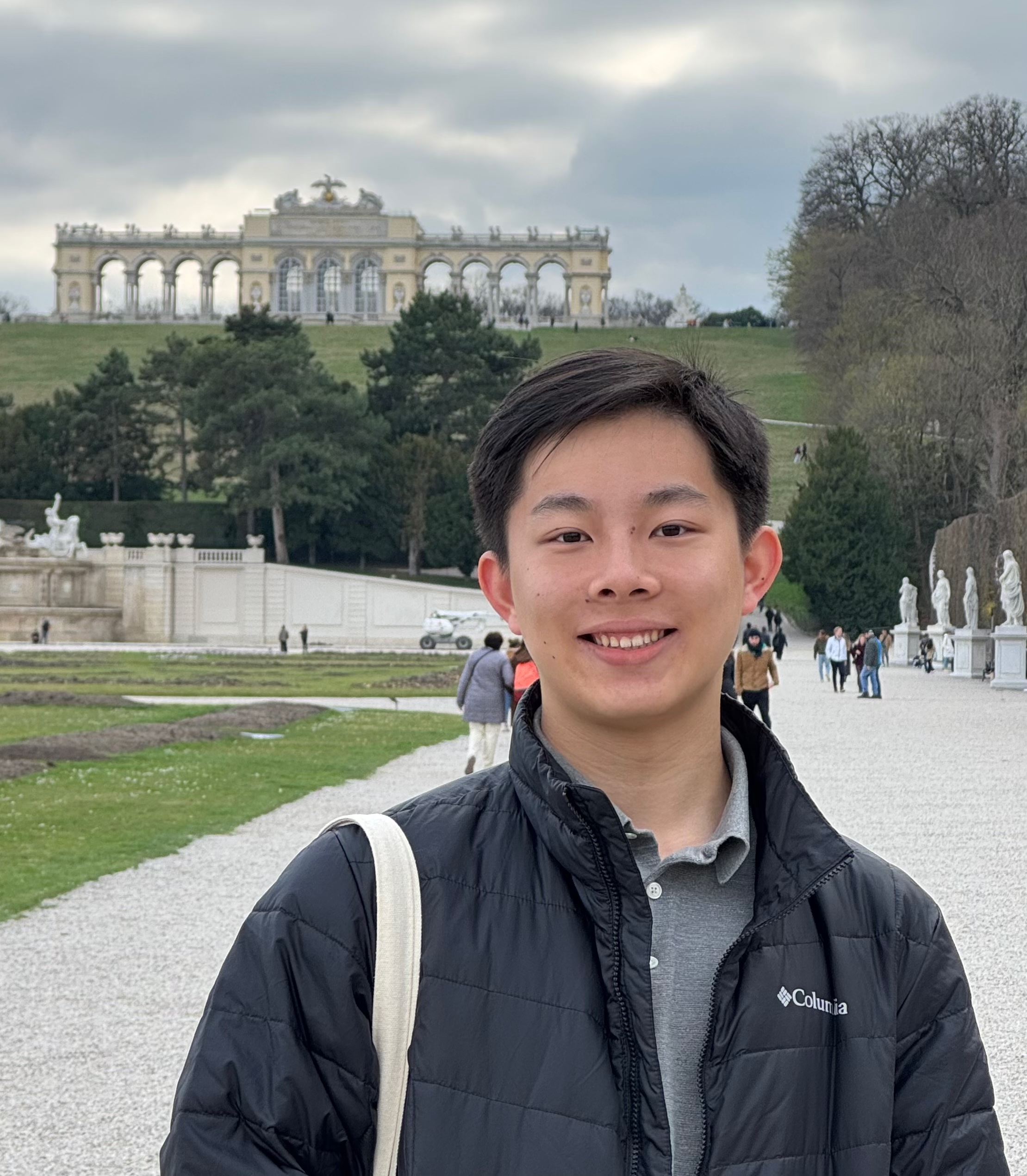
Ziyan Xie recently graduated from UCLA with a dual degree in cognitive science and computing. As a research lead at the Perceptual Processing and Computational Lab, he develops VR experiments and pipelines for psychophysics data collection. His interest lies in visual computing and immersive analytics. He builds systems to understand how interfaces shape performance, comprehension, and trust.